
Les Misérables ch 10 – 14

Update: 10.01.2018 – ch 10 …very long reading today!
- I was glad I read the notes before I started this chapter.
- Two characters have a long conversation.
- One is L’évêque de Digne and the other is
- le conventional G. (luminère inconnue)
- It seems Hugo has put much of himself, his own thoughts
- and feelings about his exile into the mouth of
- …le conventional G. (luminère inconnue).
After a debate with ‘vieux scélerat de G. Climax: Myriel’s political conversion. Irony: Myriel came to give a blessing but he receives one from G redoubling tenderness for ‘les souffrants’ Moral: Don’t judge someone until you’ve walked a mile in their shoes. #lesmisreadalong ch X

Update: 11.01.2018 ch 11 …flashback 1809-1815
This was a difficult chapter to follow in French.
Metaphors: Hugo uses the metaphors between light and dark. M. Myriel had his bitter moments (heure d’amertume), his clouded thoughts (son nuage). But he never lost sight of the three pure lights: truth, justice and charity.
Napoléon: was a surrogate father chosen by Hugo to replace his Royalist general father. His father deserted the family for a mistress.
In this chapter the great writer in exile (Hugo) lets M. Myriel give a touching analysis of the great fallen emperor Napoléon.
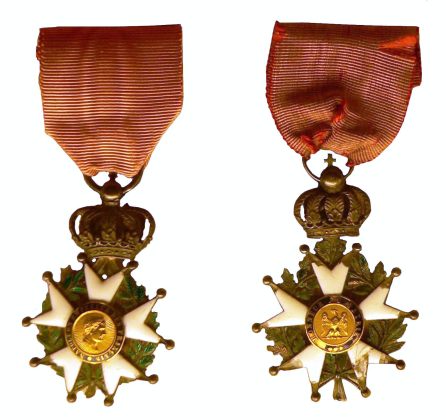
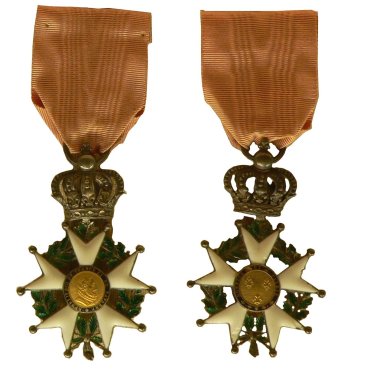
Symbol: Imperial Legion of Honor medal created by Napoléon 1802 was changed by the Louis XVIII. The images of Napoleon and his eagle were removed and replaced by the image of King Henry IV.
Hugo relates the anecdote of a porter of the town hall. He refused to wear the medal adorned with 3 fleur-de-lys (les trois crapauds = toads).
I tried to figure out why the comparison with toad? I think this picture will explain! You see the curved petal of the flower resembles the legs of the amphibian!

Late Empire Légionnaire insignia: the front feature Napoleon‘s profile and the rear side of the medal , the imperial Eagle. An imperial crown joins the cross and the ribbon.
Louis XVIII era (1814) Knight insignia: the front features Henry IV‘s profile and the rear side of the medal the arms of the French Kingdom (three fleurs de lis). A royal crown joins the cross and the ribbon.
Update: 12.01.208 ch 12 ….this was a puzzle!

- One of the shortest chapters….but one of the most confusing chapters.
- This chapter adds nothing to the narrative.
- It was inserted after the original publication date in 1862.
- Les Misérables was expensive book and
- …not accessible to the general reading public.
- The critiques were the first ones to print their reactions.
- Harsh criticism came from Alexandre Dumas.
- Trivia: In 1833 Hugo supported the accusations of plagerism against
- Dumas and his book The Three Muskateers.
- At that point friends became rivals.
- Dumas was quick to seek revenge.
- He described reading Les Misérables “like wading through mud“
- In ch XII Hugo alludes to Dumas
- “ils appellent Beauté la figure de Mousqueton…”
- But the last sentence ( in my opinion) is a direct jab at Dumas!
- He confuses the chasm, the abyss of constellations and stars
- where Hugo lets his thoughts as a poet and novelist roam…
- …with the imprints left in the mud by ‘canards‘
- ….simple animals that plod along (Dumas).
- Dumas was a feuilletoniste who wrote
- …serials because he was pressed for cash.
- Hugo thought Dumas wasted his talent.
- Hugo was haunted by shadows but the
- …darkness of the cosmos was his source of inspiration.

Update: 13.01.2108 ch 13 and 14 …end vol 1 book 1 – end of week 2!
- I read these chapters and they were probably inserted to
- …guide the narrative away from a contemplative ‘saint’.
- George Sand deplored the use of a bishop of Digne to open a book
- …concerned about socialist issues.
- Hugo closes volume 1, book 1 and we are ready for the real action!
 NancyElin.blog
:) thanks for the comment….What did you think of my ‘insights’ after this research?
I’ve fallen behind a couple of chapters this w/e, but will hopefully catch up tonight after dinner.
Thanks for finding the picture comparing the frog and the fleur-de-lys – it makes sense now.
Mphadventuregirl….perhaps you would like (editor) Kathryn Grossman’s book “Les Misérables and its Afterlives Between Page, Stage and Screen”