
#AWW2018 Alicia Sometimes (poet)
- Author: Alicia Sometimes
- Poem: Kilonova
- #AWW2018
- Published: in The Best Australian Science Writing 2018
Introduction:
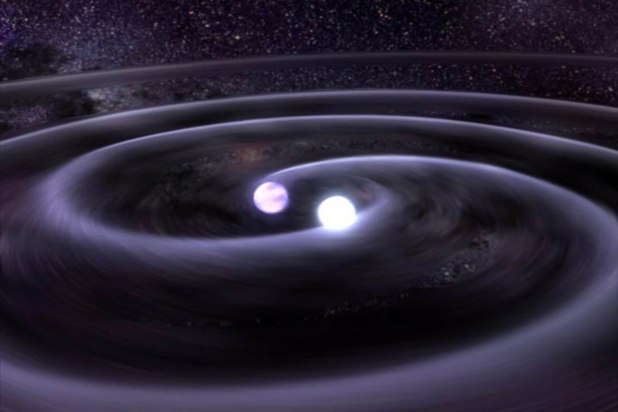
- This artist’s impression video shows how two tiny but very dense
- neutron stars merge via gravitational wave
- radiation and then explode as a kilonova.
- At its most basic, the gravitational wave discovery
- confirmed the existence of black holes, which is no mean feat.
- Thankfully, we have art – and poetry – to help us visualize
- ….what the discovery of gravitational waves will mean.
- Click HERE to watch the video ……and read the poem.
- You will be amazed how beautifully Alicia Sometimes
- …has explored the connection between
- …science & poetry & visual art.
Kilonova
We are detectives
We eavesdrop
Billions of years ago
two neutron stars
circle each other
desperate and breathless
finishing their last
pressing conversation
Remnants of once intense lives
cascade into a final spiral
until they embrace
smashing platinum
and gold into existence
a violent coalescence
outshining at least 100 billion suns
their collided mass
propagating gravitational waves
across the fabric of space
at light speed
gamma rays detected
only a moment after
We were watching
We were listening
We saw them encompass
each other completely
with their final words
rippling right through us
Last thoughts:
You can enjoy this poem on many levels:
Language:
- POV: first person plural, personal experiences
- We = scientists
- They = two neutron stars
- Personification: two star-crossed lovers
- breathless
- having conversation
- they embrace
- with their final words…
- Form: Line length, stanza breaks, white space
- mirror the emotion annd rhythm of its content.
- Title: Kilonova – a star that suddenly becomes thousands of times brighter
- Vocabulary: the poet uses words found in scientific articles
Scientific back round:
What is the science used in this poem? – gravitational waves
- Astronomers detected particles being accelerated by a
- rapidly rotating neutron star as it passed by the massive star it orbits.
2013:
- Source of a gravitational wave, created by
- merger of two neutron stars observed for the first time.
- This merger created a kilonova that ejects
- heavy elements such as gold and platinum into space.
2017:
- First detection of a collision of two neutron stars
- This produced a gravitational wave and a a short gamma-ray burst.
- The ripples in spacetime are known as gravitational waves.
- Several teams of scientists have managed to get
- the first observational proof for a kilonova.
- Of the 100 billion stars in our galaxy,
- less than 10 are known to be this type of
- …massive star with a neutron star orbiting around it.
Alicia Sometimes

 NancyElin.blog
Love the poem