
#Classic: A Tale of Two Cities

- Author: C. Dickens
- Title: A Tale of Two Cities
- Published: 1859
- Plot: Wikipedia
- List Reading Challenges
- Monthly planning
- Classic Club Master list
Introduction:
- This book needs NO introduction…but here goes!
- A Tale of Two Cities (1859) is a historical novel.
- The plot centers on the years leading up to the French Revolution
- and culminates in the Jacobin Reign of Terror.
- Set in London and Paris, it tells the story of two men
- Charles Darnay and Sydney Carton,
- …who look similar but are very different in traits.
- The book starts with the iconic paradox:
- “It was the best of times, it was the worst of times,
- it was the age of wisdom, it was the age of foolishness…. etc.”
- The book ends with the famous haunting words:
- “It is a far, far better thing that I do, than I have ever done;
- it is a far, far better rest that I go to than I have ever known.”
Conclusion:
- You must put your “Dickens hat” on
- to get through…
- Part 1:
- cryptic beginning (Dover mail coach)
- “zoom out” ch 5 ‘The Wine-Shop’
- to give you and idea of the chaos in Paris
- gaunt scarecrows = peasants
- broken casket spilling wine = blood
- approaching tempest = revolution.
- Best quote:
- “…every wind shook the rags of the scarecrows in vain,
- for the birds (aristocrats),
- …fine of song and feather, took no warning.”
- You will need some coffee
- to get through…
- Part 2:
- Tellson’s Bank controls its staff and customers
- Best quote:
- If the bank took on a young worker
- “…they kept him in a dark place, like a cheese,
- until he had the full Tellson flavor and blue-mould upon him.”
- Father and daughter bonding (Dr. Manette and Lucie)
- Emerging love entanglements
- French Revolution rages on
- Part 3:
- You will need kleenex
- to get through…
- the last ‘page-turning’ chapters
- …with the guillotine in the backround!
Dickens Template: – (This book contains very few ‘Dickens’ comic elements).
- Love triangle: Lucie Manette – Darnay – Carton
- Deaths : Marquis Evrémonde (assassinated) – Sydney Carton (guillotine, indifferent, and alcoholic attorney) – child killed under marquis’ carriage (Gaspard’s son) – Foulon (hanged, unscrupulous financier ancien régime) – Mme Defarge (shot with her own gun!)
- Nicknames: Ladybird (Lucie) – The resurrection man (Cruncher) grave robber.
- Star crossed lovers: Lucie Manette and Charles Darnay
- Little person (dwarf): None
- Little baby dies: None
- Prop: (secret) document found in chimney in cell 105 North Tower Bastille
- Dr. Manette’s letter (which is read to the court) (Book 3, ch 10)
- Eccentric but loving character: None
- Lawyer(s): Mr Stryver and Sydney Carton
- Banker: Mr. Jarvis Lorry
- Unrequited love: Sydney Carton for Lucie Manette
- Profesional money lender: None
- Villian: Mme T. Defarge
- Trusting and naive girl: None
- Young lower class gir who reached a good position: none
- Marriage: Charles Darnay and Lucie Manette
- Simpleton character….but very loving: none
- Schoolmaster: none
- Fairy godmother: none
- Maid/nurse: Miss Pross (reminds me nurse Peggoty in David Copperfield)
- Dickens likes to toss shoes in stories: Dr. Manette is also a cobbler
- Quirky names: none
- Son caring for father: none
- Daughter caring for father: Lucie Manette – Dr. Manette
- Theater: none
- Friends for life: none
- Pub: none
- Comic relief character: none
- Theme: revenge Mme DeFarge: always knitting
- “…with the steadfastness of fate”
- Malapropism: Dickens is famous for his witty malapropism:
- Cruncher speaks of the year of our Lord as “Anna Dominoes”.
- Apparently under the impression that
- ..the Christian era dated from the invention of a popular game
- …by a lady named Anna. (this book had very few comic moments…)
- Literary technique: extended metaphor “buzzing blue-flies” (book 2, ch 3)
- Flies suggest that the way the spectators hovered
- ..around the trial is similar to flies that are attracted to a potential feast.
- Dickens creates a clear comparison between the two items.
- Foreshadowing most poignant quote: book 2, ch 13 (Carton–> Lucie)
- “…think now and then that there is a man who would
- …give his life to keep a life you love beside you.”
Last Thoughts:
- After reading A Tale of Two Cites I felt closure.
- I was mesmerized by the movie version (1935) seen
- on TV in the 60s’ with my mother.
- Nothing impresses a child more than a guillotine!
- Then in high-school this was my first classic ‘study’.
- I remembered nothing about the book
- …except Mme Defarge and her knitting.
- Now it was time to re-read the book as an adult.
- #MustRead
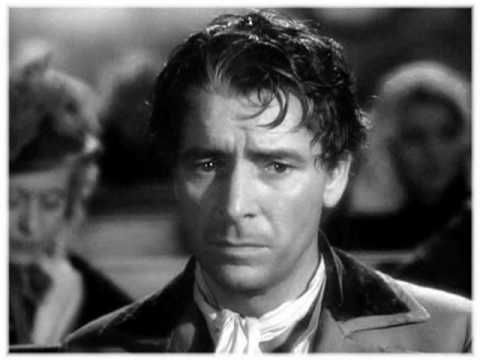
Ronald Coleman as the classic Sydney Carton.
10 Comments
Post a comment
 NancyElin.blog
I made it through this many years ago. Great book, even if it isn’t easy reading. Loved the film version with Ronald Coleman as well. Carton & Darnay’s first letters are the same as… CD – Charles Dickens. :-)
I would love to see the 1935 film version again…. :)
I like that cover! I haven’t read this one since high school myself; it’s high on the pile at the moment.
I think a cover has to make a statement
….like a good winning photograph…about the book.
Nothing ambiguous about the guillotine!
I’m so pleased to see this reread was worth it for you Nancy, I know you don’t usually reread. I was about 21 when I read this for the first time & I LOVED it. I’ve been planning on rereading it ever since to see if it holds up – from what you’ve said, it will!
Re-reads are not what I ususlly do…but this was an exception.
Plot driven…climaxing in part 3 was the main engine of the reader’s attention
writing designed to draw the reader effortlessly from page to page.
I love to laugh with Dickens….but he does know how to create one of the most famous platonic love affairs in literature!
This is one of my favourite Dickens as it’s outside his usual format. More serious and less slap-stick-ish. And not so long ….. that in itself is something to recommend it! I’m happy you loved it so much as a re-read!
Short, a bit more serious and an example of a deep love Sydney Carton felt for Lucie.
“You have been the last dream of my soul.” #ExcellentClassic