
#Poetry Month April Jericho Brown
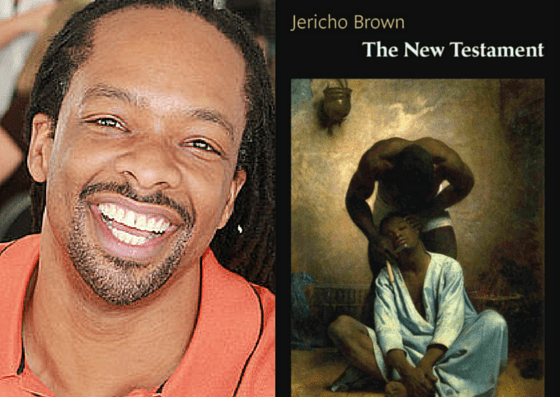
- Author: Jericho Brown
- Title: The New Testament
- Published: 2014
- Genre: poetry
- Table of contents: 41 poems
- Trivia: 2015 Anisfield-Wolf Book Award.
- Trivia: Brown holds a
- Ph.D. University of Houston
M.F.A. University of New Orleans
B.A. Dillard University. - He is an associate professor and
- the director of the Creative Writing Program
- …at Emory University.
- List of Challenges 2019
- Monthly plan
- #PoetryMonth
Narrator:
- Extended version of Jericho Brown…
- …an American gay black man attacked by society and dying of disease.
- The author became very ill with HIV in 2010.
Conclusion:
- Moving on to a new poet after spending
- days with The Facts by Therese Lloyd
- …in New Zealand is not easy.
- But ‘reading life’ goes on.
- Jericho Brown…some say he is the new James Baldwin.
- His commentary on race is deeply vivid. (see poem: The Interrogation)
- His poetry explores trauma, race, class, sexuality, spirituality.
- I’m reading Jericho Brown
- because he supplies the shock and awe
- that only poetry can express.
- I was NEVER taught poetry in school.
- Everything was about Shakespeare’s plays or
- classic like N. Hawthorne’s The Scarlet Letter or
- R.L. Stevenson’s The Deerslayer.
- Now that I have finally immersed myself in this genre.
- I loved Brown’s explanation how he got to love poetry:
- ” My mother would drop me off at the library because
- …she could not afford childcare…the best thing that happened to me!”
Last thoughts
- The downside:
- …I can only read 5-6 poems a day.
- It is just too much to absorb.
- I tried to read a poem without any foreknowledge
- …but realized some allusions went way over my head.
- So I have to study the poem…before I read it.
- It attests to the depth and intensity of the poems.
- The upside:
- … I enjoy the isolation of reading a small
- piece of prose
- …not in the mood for novels at the moment.
- There is so much to discover in
- just 20-60 lines and ….a few stanzas.
- I am amazed by Brown’s command of language
- …and his ability to combine his personal grief
- …with social injustice.
My notes on a few poems:
- According to Brown…
- “Poetry wakes us up!”
- Poetry It is not difficult.
- It asks something of us
- …that reality TV does not ask of us.”
Colosseum
- I completely missed the importance to the
- word gladiator in this poem.
- A man who stands bravely
- and fights the inevitable slaughter.
- Best quote:
- “I know how my own (slaughter) feels
- …that I live with it, and sometimes uses it
- …to get the living done.”
- Jericho Brown stands bravely in his poems
- …knowing all too well what is at stake.
Romans 12:1
- Bible text:
- “…to offer your bodies as a living sacrifice
- … your true and proper worship”
- I thought I understood the poem
- Reading the bible text gives me the
- insight that Brown is alluding to
- …offering his body to another man.
- But in the lines we discover the American
- society’s aversion to feminity in the male.
- “…my people {…} will not call me brother”
- In a podcast I heard
- Jericho Brown reveal the difficulty of separating
- a poet’s autobiography from his work.
- Writing confessional poetry is difficult when
- a person is so private…as Brown is.
- But who does it hurt more me or you to
- write these poems?
- Jericho Brown rarely speaks to his
- evangelical fundamentalist Christian parents.
- After his coming out as a gay man…his parents
- did not embrace him.
- Jericho Brown lets you hear what it is
- …like to live in his world.
Heartland
- The local doctor has a biblical echo
- “…the boy can only hope for miracles.”
- In “Heartland,” one of the book’s opening poems, Brown writes,
- “I do anything other than the human thing,”
- Central idea of the book:
- The narrator is one who doesn’t completely fit in
- …is made to feel less than human.
Labor
- Description of narrator’s Saturday odd-job cutting lawns for old ladies
- Nice sentence: “….they (mothers and big sisters)
- …want to please and pray for the chance to say please to.”
- — five-dollar bill rolled tighter than a joint! (funny)
- — tell the difference between mowed lawns and vacuumed carpets
- — “The loneliest people have earth to love…and not one friend their own age.”
The Interrogation – divided into seven parts.
II. Cross-Examination” and IV. Redirect
- Brown narrates an imagined conversation
- between himself and an interrogator.
- The narrator defends his heritage:
- (Best quote)
- “What you call a color I call
- …A way.”
- The interrogator responds:
- “Forgive us. We don’t mean to laugh
- It’s just that black is,
- After all, the absence of color.”
.
VI. Multiple Choice
- Haunting:
- “Show me A man who tells his children
- The police will protect them
- And I’ll show you the son of a man
- Who taught his children where
- To dig.”
- The exchanges between these two voices are haunting and memorable.
- The poem reminds the reader of Ferguson…
- The Ferguson Unrest (Aug 2014) protests and riots that began the day
- …after the fatal shooting of Michael Brown by police.
- The unrest sparked a vigorous debate about
- …relationship police officers and African Americans.
Paradise
- The narrator talks to his abusive father.
- The last sentence knocked the wind out of my sails.
To Be Seen
- Narrator: (Jericho Brown was diagnosed 2010 with HIV)
- recalls his doctor speaking in metaphors of war…
- ”Its always the virus that attacks the cells..”
- “Hell, I remember his saying the word SIEGE when a rash returned.”
’N’em
- Jericho Brown moved back to the south
- …after living many years in California.
- He had forgotten some missing terms he once knew.
- One of these terms is ’N’em.
- Meaning:
- that person and everyone who might associate with that person.
- Use in a sentence:
- “Hey, how you been…how’s your mama and ’N’em.
- This poem is absolutely stunning in its simplicity.
- It packs an emotional punch without cliché
- …especially in the last 2 line.
Langston’s Blues
- Persona poem in which Brown uses the voice of Langston Hughes.
- It alludes to the poem Hughes
- wrote when he was 18yr The Negro Speaks of Rivers.
 NancyElin.blog
Trackbacks & Pingbacks