
#Paris In July Food Journal

01.07.2018 Paris In July!
- I took this photo in front of a pâtisserie on L’ile St.Louis.
- This is my first stop whenever I visit Paris.
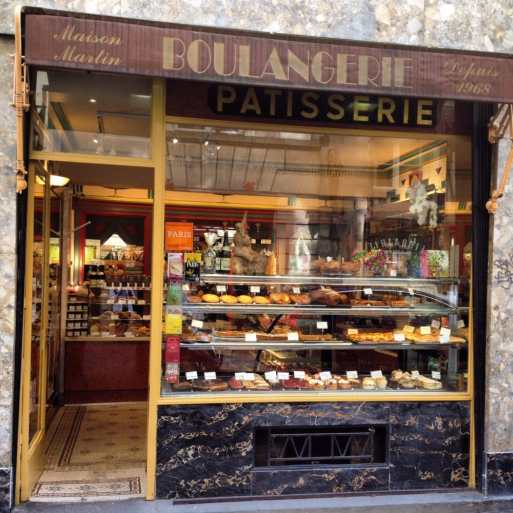
- Everything is so delicious but I always choose (lower right)
- …the mini tarte au citron!
- This month is all about Paris and anything French.
- My pâtisserie challenge this week:
- ….bake these little pies and post my results!
- What is your cooking challenge this week?

Bloody hot today in The Netherlands…time for refreshment!
Bénédictine Spritzer!
- Bénédictine is an herbal liqueur beverage
- developed by Alexandre Le Grand in the 19th century and produced in France.
- The recipe is a closely guarded trade secret,
- purportedly known to only three people at any given time. #ParisInJuly.

Paris in July 2018

- Oh, is it July already?
- Let’s have a glass of wine and
- think of some things to do for…
2018 POSTS:
Paris in July
- Paris in July is a French themed blogging
- …experience running from the 1st – 31st July this year.
- The aim of the month is to celebrate our French experiences through
- actual visits, or through reading, watching, listening,
- observing, cooking and eating all things French!
- For more instructions how to share your posts go to Thyme for Tea.
- There will be no rules or targets …just blog about anything French
- …and you can join in! Some ideas might include;
- reading a French themed book – fiction or non-fiction,
- watching a French movie,
- listening to French music,
- cooking French food,
- experiencing French, art, architecture and travel.
- #ParisInJuly2018

What are my plans?
- Book: Et Soudain, La Liberté by É. Laurent winner Prix Marguerite Duras 2017
- Book: Comment Baptiste est mort by A. Blottière winner Prix Jean Giono 2016
- Cocktails: make, drink, review a surprise French iconic cocktail
- …and on 19th July is National Daiquiri Day….try a French Daiquiri!
- Cooking: Gratin Dauphinois (pg 34) La Petite Cuisine à Paris by R. Khoo.
- Movie: Frantz won Best Actor Pierre Niney César Awards, France 2017.
- Netflix: Dix Pour Cent Season 1 series – nominee International Emmy Awards 2016.
- Art: Berthe Morisot by D. Bona winner Prix Goncourt de la biographie 2000.
Tartuffe
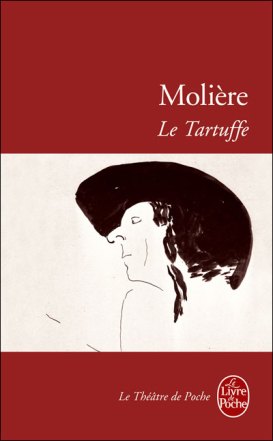
- Author: Molière
- Title: Tartuffe
- Language: French
- Preformed: 1669 first time Paris, Palais-Royal
- after being censured for years by the King.
- Trivia: List Reading Challenges 2018
- Monthly reading planning
- List of French Books
- List of Plays ( TBR)
Definition tartuffe:
- A person under the cover of a profound religious
- devotion and virtue tries to seduce
- his followers (entourage) for his own profit.
| Character | Description |
|---|---|
| Orgon | Head of the house and husband of Elmire, he is blinded by admiration for Tartuffe. |
| Tartuffe | Houseguest of Orgon, hypocritical religious devotee who attempts to seduce Elmire and foil Valère’s romantic quest. |
| Valère | The young romantic lead, who struggles to win the hand of his true love, Orgon’s daughter Mariane. |
| Madame Pernelle | Mother of Orgon; grandmother of Damis and Mariane |
| Elmire | Wife of Orgon, step-mother of Damis and Mariane |
| Dorine | Family housemaid, who tries to help expose Tartuffe and help Valère. |
| Cléante | Brother of Elmire, brother-in-law of Orgon |
| Mariane | Daughter of Orgon, the fiancée of Valère and sister of Damis |
| Damis | Son of Orgon; and brother of Mariane |
| Laurent | Servant of Tartuffe (non-speaking character) |
| Argas | Friend of Orgon who was anti-Louis XIV during the Fronde (mentioned but not seen). |
| Flipote | Servant of Madame Pernelle (non-speaking character) |
| Monsieur Loyal | A bailiff |
| A King’s Officer/The Exempt | An officer of the king |
Dramatic irony:
- M. Orgon is “blind”.
- He thinks Tartuffe will help him attain a place in heaven
- through pious devotion.
- Orgon offers Tartuffe a place in his home,
- his assets and even betrothed his daughter to the rascal.
- The family members (except his mother Mme Perenelle)
- and audience are aware of Tartuffe’s hypocrisy.
Plot:
- The plot is easy to follow and you can find all that information
- on the Tartuffe wikipedia page.
Conclusion:
- Reading this play was hard work.
- But I put in the hours and have made some discoveries.
- Molière was writing for his time and the play feels outdated.
- France had just witnessed the manipulation of
- Queen Anne of Austria by the
- La Compagine du Saint-Sacrement, a fundamentalist religious society.
- Anne was named regent upon her husband’s death (Louis XIII).
- Their four-year-old son was later crowned King Louis XIV of France.
- Moliere wanted to denounce by means of the play ‘Tartuffe”
- the power of this society.
- The society denounced heretics,
- …libertine morals and other pastimes the French love.
- it functioned as a sort of Inquisition!
- The King of France and the Bishop of Paris had the play banned!
Last thoughts:
- After reading the play I felt I was missing something.
- I decided to watch a french version on
- ….You Tube and follow the script.
- It was awful!
- The stage design was minimalist
- …costumes were drab (looked like rags….)
- …and the actors did not bring the nuances I hoped to find.
- All they did was shout!
- Again…I felt I was missing something.
- I decided to watch the Royal Shakespeare Company
- TV version broadcast in November 1985 on BBC
- …adapted by the Oscar winner writer Christopher Hampton.
- It was an absolute delight to watch such great English actors as
- Nigel Hawthorne as Orgon and Sir Anthony Sher as Tartuffe.
- Sher is unquestionably a Tartuffe that even Molière would love!
- I’m sure the film is available at better libraries…
- and here is the link for the play on You Tube.
- My advice? Read the play in English
- …if you are feeling adventurous …read it in French.
- Then sit down and enjoy this wonderful production
- of Tartuffe by Molière.
Trivia:
- Christopher Hampton (British playwright, 1946)
- has penned a new adaptation of Molière’s
- classic comedy Tartuffe, which will begin performances
- May 25 2018 at the Theatre Royal Haymarket, London.
- It will be directed by Gerald Garutti.
- In this new adaptation, the 17th century comedy moves to America, where a
- French film tycoon finds his life uprooted by Tartuffe.
- He is a radical American evangelist.
- Hmmm…interesting!

P
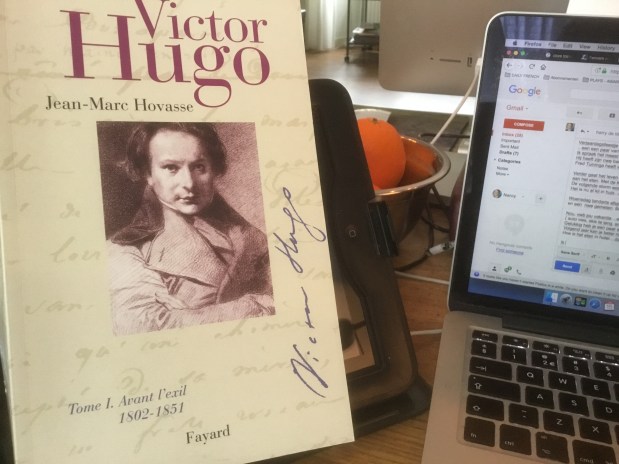
Victor Hugo vol 1 (1802-1851)

- Author: Jean-Marc Hovasse
- Title: Victor Hugo: vol 1 Avant l’exil 1802-1851 (1159 pg)
- Published: 2015
- Trivia: Monthy Reading Plan
- Trivia: Challenges 2018
- #LesMisReadalong
- @nicksenger.com
Conclusion:
- I took me 3 weeks to read this book.
- I was exhasted when I reached pg 1159
- It felt like brushing my teeth, it became a daily habit.
- I jotted down some thoughts during my reading.
- It is impossible to give a review of the total book.
- I just cannot remember everything.
- I hope you can glean some information
- …from my notes that will interest you.
Notes:
Autobiographical: Hugo saturated all his works with memories, confidences and fragmented confessions. The author embedded characters/places in his poems and stories that were linked to his own name Hugo or people in his childhood.
There is secret code in Les Miserables that only Hugo and his long time lover Juliette Drouet would understand!
Notes: amazing family tree HUGO from father and mother’s side -ending with Hugo’s granddaughter Jeanne (1869-1941).Hovasse even includes the family tree of Victor Hugo’s (1802-1885) long time mistress Juliette Drouet (1806-1883)!
Notes: Some think Victor Hugo’s father was `not Leopold Sophie’s husband…but her lover General Victor Lahore! She asked him to be Hugo’s godfather and she named the baby after him! Hmmm.
Marriage of Hugo’a parents: Leopold and Sopie, was a train wreck!
Trivia: Tome IV, livre II, chapitre III. Il est intitulé “Apparition du père Mabeuf”
The character M. Mabeuf is a reference to a dictée that Victor Hugo completed when he was 7 years old. He made just one mistake…he left the ‘O’ out of boeuf! That simple incident found its way into one of the greatest novels written!
Trivia: The family life Valjean experienced rue Plumet resembles the 18 months that Hugo spent in Feuillantines….this was the first time he felt a loving family feeling….he was 7 yrs old.
Personage: Outlaw Jean Valjean is modeled on General Lahorie Victor Hugo’s godfather.
Spain: Victor Hugo’s father was stationed in Spain (general) and Victor spoke better Spanish than French at the age of 10 yrs old.
LesMis: chapter 1817 -this is a list of ‘triva’ that occurred in 1817. The most important fact is left out. Victor Hugo had entered a poem in the contest for Prix Poesie de L”Academie française…..and got an honourable mention. He was only 15 yrs but it was his official debut as a man of French Letters!
Quote: pg 210: Hugo’s advice: Live simply as other men…see what they see, feel what they feel and think a little more than they think!
Autobiographical: Hugo was living on a very small budget 1822 and sharing a room with his cousin Aldolphe. Reading LesMis notice the Marius’s budget this describes the real situation of Hugo! Marius and Hugo both had only 2 suits!
Autobiographical: The marriage of Marius and Cosette is a mixture of fact and fiction. The date of the marriage represents the first night with Juliet Drouet, VH’s long time lover, 16.02.1833.
The place of the wedding is not St. Suplice where VH and Adele were married….but Hugo moved it to St. Paul where he beloved daughter Léopoldine married her husband.
The sudden departure of Valjean from the marriage celebration represents the break with Eugène, Hugo’s brother, who was secretly in love with Adele himself. The description of the marriage night in Les Mis is apparently not of Hugo’s actual wedding night (12 Oct 1822) but the first night with Julliet Drouet (16 Febr 1833). Ouch!
Reading plan: the book turns out to be more than a biography…it is a guide through the Romantic period…and brushing against the next movement that was a reaction to Romanticism….’Parnassianism’.
I found that some chapters were difficult to read because I did not know many poets mentioned.
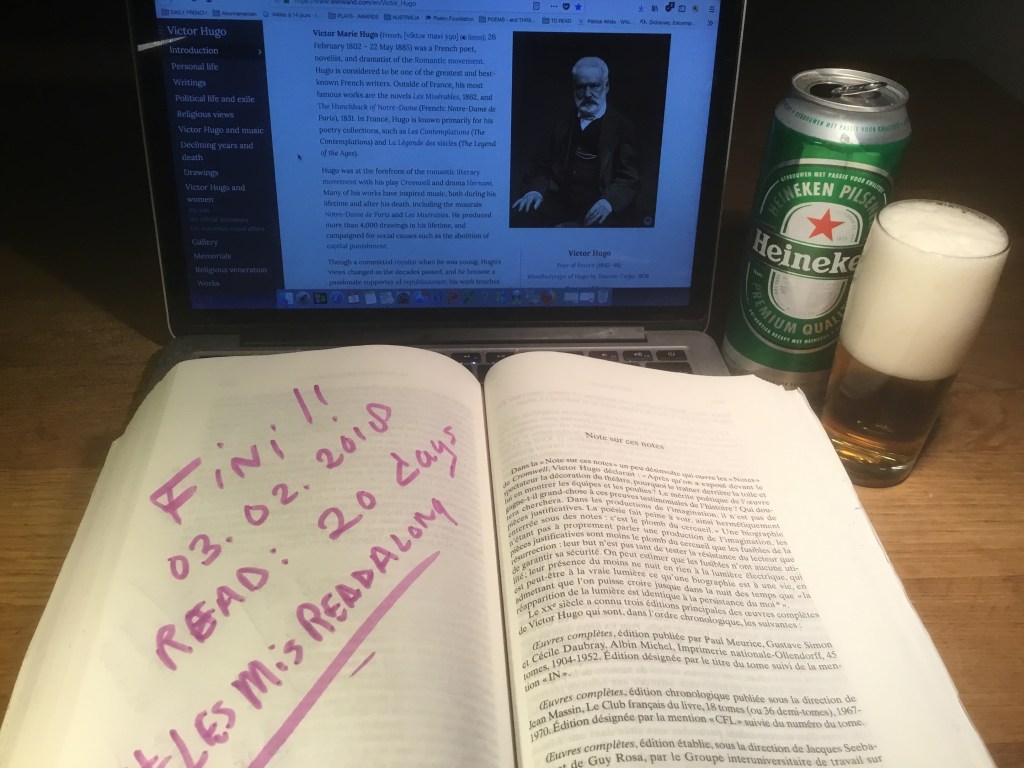
Trivia: Victor Hugo preferred beer over wine!
LesMis: Fantine is born 2 days after Victor Hugo was elected to Academie française (1841). Hugo witnessed a young girl being harassed in the street…this became Fantine.
M. Madeleine = Victor Hugo. Hugo is now taking notes about ‘les temps présents’ to help his move from literature to politics.
Wedding: Victor Hugo’s daughter Léopoldinen married on 15 Febr 1843. The ceremony was moved 1 day forward as not to coincide with 10th anniversary the affair H had started with Juliette Drouet. Cosette’s wedding day DID correspond with 16 February and was a coded message to Hugo’s mistress Juliette. Cosette’s wedding gown is the description of the dress Léopoldine wore on her wedding day.
Note: I was surprised how quickly Hovasse handed the wedding and death of Hugo’s most beloved daughter. It was done in 3 pages! Yet the reader is dragged through an ‘analyse extrêmement poussée’ (highly detailed) day to day description of 8 road trips!
Note: pg 948-952 1845: …very touching moments between Louis-Philippe (25 yrs older than VH) and the poet. Louis Philippe asked VH to linger after other guests left. LP spoke candidly and hoped VH would be a witness for history and reveal the man LP really was under the burden of the crown of France. Hugo wrote a condense version of these conversation is his chapter ‘Louis-Phillippe” in LesMis. (volume 4 ‘St Denis’, book 1 ch 3)
Updates Goodreads:
15.01.2018
Massive biography and it is only vol 1 (1802-1851)..but is is so good!
It read like a novel!”
16.01.2018
Victor Hugo ‘s writing is saturated with confidences and fragmented confessions. In 1871 after his exile Hugo visited many sites from his childhood. He was sad to see that only a patch of grass and a dilapidated section of a wall was left. “It was not worth looking at if not with the profound eye of memories”
20.01.2018
#LesMisReadalong + reading biography of V. Hugo:
Victor experienced a sad childhood coping with a messy and bitter divorce of his parents. Hugo was sent to boarding school (imprisonment was more like it…) by his father. Education was strict but Victor still managed some ‘joie de vivre’ by memorizing 30-40 lines of Hoarce or Virgil each night and in the morning translated the verses into French.
He was just 13 yr.
23.01.2018
#LesMisReadalong Poet friends (romantics, Royalists) A. Soumet, A. de Vigny turn a cold shoulder towards Hugo….as his political views dirft into liberalism. This hurts the sensitive Victor.
24.01.2018
#LesMisReadalong – very little about personal life of Victor Hugo only a few pages about his wedding (12 Oct 1822), birth son (1823-1823) and joy when daughter Leopoldien is born and is healthy. The rest was about literary publications (la Muse Francaise) and other poets involved. Hugo attends coronation King Charles X in Reims. All in all…a lot of reading and found only 2 references to things in Les Mis.
26.01.2018
#LesMisReadalong: Keep reading Les Mis daily chapter then…tackle the massive biography. Stats: 10 days, read 5 of 10 chapters, 380/1159 pages, Victor Hugo is 27 yr and just published his famous Odes and Ballads (1829) Expected more personal history but the emphasis is mostly on his writings, the Romantic movement and the other family, poets, publishers, illustrators and friends that swirl around Hugo. Exahusted.
28.01.2018
#LesMisReadalong – Success has its dark side. VH is only 28 yrs old and his world is starting to crumble. Brouhaha about play Hermani (banned by Charles X), defied censure and the play is a hit. Unfortunately VH is blind and does not see his marriage weakening under the pressure of fame. The ultimate deception: does Adèle feel more than friendship for VH’s closest friend Saint-Beuve? VH is a genius but feels weak.
29.01.2018
#LesMisReadalong – trivia about Victor Hugo
Crushing reviews of Notre-Dame de Paris (1831):
Stendhal thinks it is muck
Sainte-Beuve thinks it is not catholic enough.
Montelembert likes part about ND’s architecture….the rest, mèh!
Goethe thinks its is abominable…could hardly finish it.
Chateaubriand….no comment.
Oh, critics…..what do they know?
Notre-Dame de Parsis is still a classic!
30.01.2018
#LesMisReadalong- trivia: Victor Hugo used the biography of his mistress (Juliette Drouet) as a basis for Fantine….both orphans at a young age, placed in the care of a convent..both had to a struggle to survive.
This book is more than a biography…it is a panoramic view of the literary world of Paris 1790-1885. Classicists – art for art’s sake VS Romantics – usefulness of art for political and social change.
31.01.2108
#LesMisReadalong – Love affair with Juliette Drouet is dripping with passion. JD writes him every day…VH is not reading them as he used to. JD does not even come close to Mme Sévigné’s style. (dame des belle lettres 1626-1676). How many times can you say je t’adore? We get it!. The reader knows that VH will be starting his next romance with Leonie d’Aunet in 1837. VH is drawn to ladies like a moth to a flame!
01.02.2018
#LesMisReadalong- VH travels with Juliette but he is always taking notes, making sketches of cathedrals, architecture, towers. Visits ‘bagne’ (prison) in Toulon and Brest leave lasting impressions that he used in Les Mis. VH is elected to Academie française and L’ Assemblée. Death of Balzac leaves VH stunned…(1850). Life is still complicated: VH has wife, 4 children 2 mistresses (Juleitte, Léonie) and muse, Louise.
03.02.2018
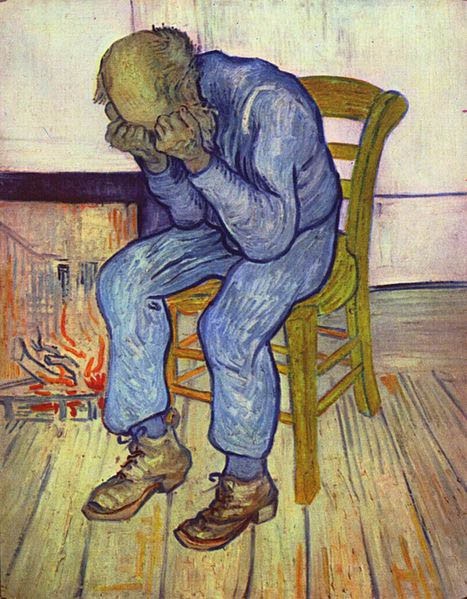
#LesMisReadalong I needed some visual by Vincent Van Gogh to push me today. Starting the last 100 pages of Victor Hugo bio (very long book in French ) and I am determined to reach the finish line tonight! #NeedCoffee
Finally VH achieves his goal…be the next René Chateaubriand! RC was 32 years older than VH and his role model. RC was poet and given peerage in 1815. VH was poet and given peerage 1845. He entered the Higher Chamber as a pair de France, where he spoke against the death penalty and social injustice, and in favour of freedom of the press and self-government for Poland.
Looking ahead….Note: Vol 2 Book 6 ch 7 coded message and reference to mistess Juliette Drouet
The names of Gauvain and Drouet are metioned.
Gauvain is Juliette’s family name and Drouet is the name she took for the theater. It is the name of a military uncle who adopted her at an early age.
Last chapters Whew: ..a lot of politics! Thriling to read how Victor Hugo managed to escape Paris 05.02.1851 after coup’d’état with a price on his head of 25.000 francs!
…Victor is only 49 yr…ready to go into exile after coup d’état 02 December 1851. We still have a long way to go! But having witnessed the massacres on the barricades….Hugo is determined to write down all that he saw in Les Misérables! #LesMisReadalong
Lemaitre: Couleurs de l’incendie

- Author: P. Lemaitre
- Title: Couleurs de l’incendie
- Published: 2018
- Trivia: List Reading Challenges 2018
- Trivia: Magic Square Challenge – A Translated book
- Monthly reading plan
- Theme: morality of revenge …when is revenge justified?
- Plot: Main character (Madeleine) has been wronged and becomes obsessed by revenge.
- Classic elements: disguise, deception and ‘framing’ victim with false evidence
- Arch-types:
- Madeline: The Mistreated Villain:
- A character who does things which the audience perceives as wicked,
- ….but only because he has been driven to them by the way she has been treated.
- Gustave: The Flawed Ruler:
- This powerful man with a flaw which causes his downfall.
- Paul: The Innocent Babe:
- The babe is often a victim of malignancy and
- …is the trigger for the revenge played out in the plot.
- M. Dupré: The Sidekick/The Clever ‘fixer’:
- The friend who helps main character carry out her Machiavellian plans.
Conclusion:
- This book is the second in Lemaitre’s new trilogy.
- The first book Au revoir là-haut was dazzling!
- The film version has just been nominated for 13 Caesars (French Oscars)
- If you haven’t read it….then put it on your TBR!
- With regards to Couleurs de l’incendie
- ...it left me wanting.
- It was missing something:
- the magical, lyrical text (1st book ‘clever scam’)
- no dramatic dialogue: heated rhythmic dispute to create a powerful effect.
- (1st book: Alfred and Edward were always arguing)
- In Couleurs de l’incendie …it was all ‘comme il faut’.
- Lemaitre uses ‘breaking The fourth wall only a few times.
- This is the imaginary wall that separates
- …the readers from the characters in the story.
- Perhaps he could have done that more often to draw ‘this reader’
- into the book.
- I read this book, but I was not ‘swept off my feet’ .
- I hope we will see more of his thrillers (polars) in the future.
- That is Pierre Lemaitre’s strongest genre.
Last thoughts:
BOOK: disappointing:
ALTHOUGH TEMPTED – Bien que tentée
AFTER HAVING HEARD – après avoir entendu ( after hearing…)
A REVIEW – une critique littéraire,
A READING OF THE BOOK – la lecture de ce livre
FINALLY DISAPPOINTED ME – m’a finalement déçue
Rien à voir avec (nothing like….)
Au-revoir là haut. Dommage !
Psychanalyse de Victor Hugo
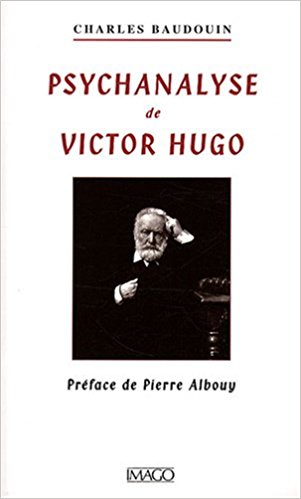
- Author: Charles Baudouin (1893 – 1963) was a French-Swiss psychoanalyst
- Title: Psychanalyse de Victor Hugo
- Published: 1943 (original) later in Paris, Ed. Imago, 2008.
- Trivia: read for information to help me with #LesMisReadalong
- Trivia: Monthy Reading Plan
Conclusion:
- This book was written in 1943 yet it never felt dated.
- I read it just to discover more about Victor Hugo the man.
- The book concentrates on the images used in Hugo’s poems.
- The use of antithesis for example…
- lumière-ombre, bien-mal, naissance-mort, amour-haine.
- The book is not available in English….so I struggled in French.
The author explained many complexes that Hugo was struggling with:
- Oedipus – demanding exclusively the love of his mother
- Guilt – brother Eugène became insane on Hugo’s wedding day and never recovered .
- His brother was madly in love with Adèle Foucher as well.
- The Chase – (poursuite) Les Mis: Valjean, the outlaw
- …his fate (fatalité) purses him.
- Retreat – (retraite) flee from tyrannical father = outside world
- —> to mother = refuge
- Les Mis: Valjean receives refuge in a convent.
- Convent is a typical symbol of a retreat…a maternal aisle.
His exile on Jersey and Guernsey felt like a new freedom.
- Hugo was constantly trying to reach the unconscious mind.
- He built a special porch on his house to gaze into
- … the heavens, stars, cosmos and the sea.

Shadows and darkness permeate Hugo’s thoughts.
- He believed that the darkness, the night was the normal state of our lives.
- Daylight was only here because our planet was close to a star….the sun.
- Abyss (gouffre) is mentioned more than 40 x in Les Misérables.
There are a few symbols that might be used in Les Misérables…..
- Spiderweb – In Notre-Dame Follo watches the
- fly struggle with the spider.
- It represents man’s struggle with inescapable fate (l’araignée)
- Spider – symbol of “La Mere terrible” who succeeds
- to imprison child in the chains in her web.
- Birds – represent passionate, free search into doctrines (bird = ideas)
- Window – linked to the subconscious
- …a place where you can drift into your memories/thoughts.
- Cord (rope) – dropped into a well….feeling of mystery, anguish
- Hibou (owl) – represents skepticism
- Chavue-souris – (bat) represents atheism
- Deep well (puits) – eternal mystery
- “ Quel puits que le coeur humain…” pg 1265 Les Mis
Charles Baudouin
Là-bas, août est un mois d’automne

- Author: Bruno Pellegrino
- Title: Là-bas, août est un mois d’automne (224 pg)
- Published: 2018
- List of French Books
- Monthly reading planning
Conclusion:
- It takes talent to write such a touching and subtle debut novel.
- The book is inspired by the life of
- …poet and photographer Gustave Roud. (1897-1976)
- He is one of Switzerland’s most accomplished poets.
- Pellegrino describes the ‘mouvement de va-et-vient’
- …the daily comings and goings
- …of two 60+’ers, brother and sister, Gustave and Madeleine.
- They have lived a solitary life on their family farm at Carrouge (canton Vaud).
- They both yearn to love and be loved each in their own way.
- Pellegrino has a keen eye for the micro cosmos of the garden.
- It is the world that
- …reflects the changing seasons of the character’s lives.
- Happy or sad, public or secret, healthy or weakening with age,
- …all is given the reader in an almost poetic style.
- This style ‘la belle expression“
- is an adornment and shield
- …it is like the enamel on a tooth.
- Bravo, Bruno Pellegrino!

Les Misérables ch 10 – 14

Update: 10.01.2018 – ch 10 …very long reading today!
- I was glad I read the notes before I started this chapter.
- Two characters have a long conversation.
- One is L’évêque de Digne and the other is
- le conventional G. (luminère inconnue)
- It seems Hugo has put much of himself, his own thoughts
- and feelings about his exile into the mouth of
- …le conventional G. (luminère inconnue).
After a debate with ‘vieux scélerat de G. Climax: Myriel’s political conversion. Irony: Myriel came to give a blessing but he receives one from G redoubling tenderness for ‘les souffrants’ Moral: Don’t judge someone until you’ve walked a mile in their shoes. #lesmisreadalong ch X

Update: 11.01.2018 ch 11 …flashback 1809-1815
This was a difficult chapter to follow in French.
Metaphors: Hugo uses the metaphors between light and dark. M. Myriel had his bitter moments (heure d’amertume), his clouded thoughts (son nuage). But he never lost sight of the three pure lights: truth, justice and charity.
Napoléon: was a surrogate father chosen by Hugo to replace his Royalist general father. His father deserted the family for a mistress.
In this chapter the great writer in exile (Hugo) lets M. Myriel give a touching analysis of the great fallen emperor Napoléon.
Symbol: Imperial Legion of Honor medal created by Napoléon 1802 was changed by the Louis XVIII. The images of Napoleon and his eagle were removed and replaced by the image of King Henry IV.
Hugo relates the anecdote of a porter of the town hall. He refused to wear the medal adorned with 3 fleur-de-lys (les trois crapauds = toads).
I tried to figure out why the comparison with toad? I think this picture will explain! You see the curved petal of the flower resembles the legs of the amphibian!

Late Empire Légionnaire insignia: the front feature Napoleon‘s profile and the rear side of the medal , the imperial Eagle. An imperial crown joins the cross and the ribbon.
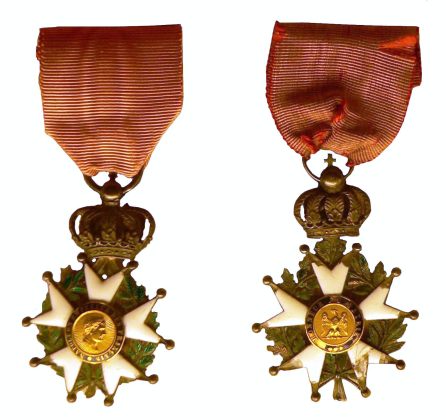
Louis XVIII era (1814) Knight insignia: the front features Henry IV‘s profile and the rear side of the medal the arms of the French Kingdom (three fleurs de lis). A royal crown joins the cross and the ribbon.

Update: 12.01.208 ch 12 ….this was a puzzle!

- One of the shortest chapters….but one of the most confusing chapters.
- This chapter adds nothing to the narrative.
- It was inserted after the original publication date in 1862.
- Les Misérables was expensive book and
- …not accessible to the general reading public.
- The critiques were the first ones to print their reactions.
- Harsh criticism came from Alexandre Dumas.
- Trivia: In 1833 Hugo supported the accusations of plagerism against
- Dumas and his book The Three Muskateers.
- At that point friends became rivals.
- Dumas was quick to seek revenge.
- He described reading Les Misérables “like wading through mud“
- In ch XII Hugo alludes to Dumas
- “ils appellent Beauté la figure de Mousqueton…”
- But the last sentence ( in my opinion) is a direct jab at Dumas!
- He confuses the chasm, the abyss of constellations and stars
- where Hugo lets his thoughts as a poet and novelist roam…
- …with the imprints left in the mud by ‘canards‘
- ….simple animals that plod along (Dumas).
- Dumas was a feuilletoniste who wrote
- …serials because he was pressed for cash.
- Hugo thought Dumas wasted his talent.
- Hugo was haunted by shadows but the
- …darkness of the cosmos was his source of inspiration.

Update: 13.01.2108 ch 13 and 14 …end vol 1 book 1 – end of week 2!
- I read these chapters and they were probably inserted to
- …guide the narrative away from a contemplative ‘saint’.
- George Sand deplored the use of a bishop of Digne to open a book
- …concerned about socialist issues.
- Hugo closes volume 1, book 1 and we are ready for the real action!
Les Misérables Chapter-a-Day Read-along

Twitter: @burns_nancy
01-07 January: weekly summation of my thoughts.
- Nick Senger @ onecatholiclife.com is hosting a year long
- …read-along of Les Misérables by Victor Hugo.
- I have been reading French for the past 5 years
- I started with the 20 book by Emile Zola
- …the Les Rougon-Marquart series.
- That took me two years to finish.
- Often I try to find a really good book French Book
- … but even Goncourt Prize winners are lacking.
- Now I have decided to return to the classic Victor Hugo.
- I have never read anything about this novel, not seen movie or musical.
- This is a read-along with a writer I expect will not disappoint!
- I will follow the informative posts that Nick will publish
- …downloaded the reading schedule and
- …hope to finish this book by the end of the year!
- I will be reading it in French….nothing lost in translation, :)
- #LesMisReadalong
Soixante-quinze: French ’75’ Cocktail
- I have been looking for
- … reason to use my VSOP Calvados.
- This cocktail originated at the front during WWI in France.
- It was introduced to America by war correspondent Alex Powell.
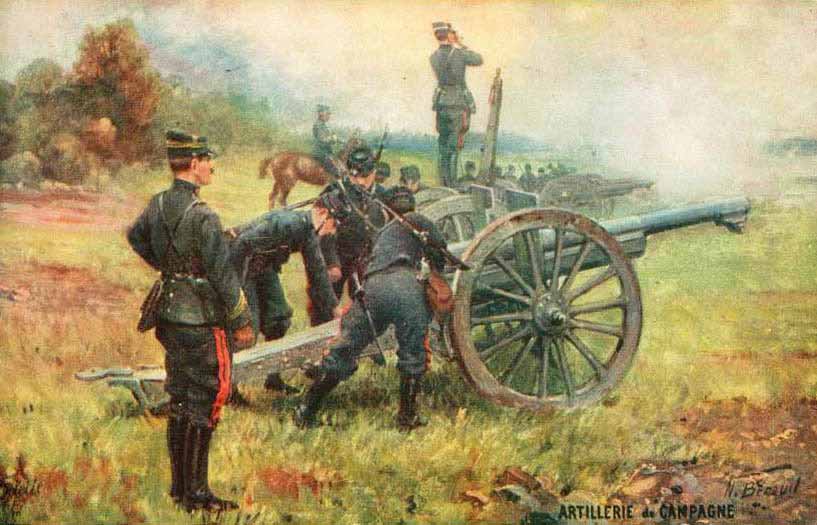
- The French 75 Cocktail is a tribute to the
- 75mm artillery piece that the French fielded in World War I.
- The French air squadrons in WWI had their drinking rituals.
- The “75,” was inspired by these flyers returning from battle.
- Trivia: The power and efficiency of the French 75mm guns made
- them well trusted among their crews, which earned them
- …a particular affection.
- They were dubbed Mademoiselle Soixante-Quinze (Miss Seventy-five)
- ….and appear on numerous French propaganda cards.
- #ParisInJuly
Ingredients: Gin – Calvados brandy – grenadine or absinthe (or both)
- 60 ml VSOP Calvados
- 30 ml gin
- 1/2 TB (7.5 ml) grenadine (no absinthe in my bar…)
- 1 tsp (5 ml) lemon juice
- Add ingredients to a cocktail shaker filled with ice
- Shake, strain into chilled cocktail glass with lime wedge
- Garnish: lemon twist
- Glass: elegant stemmed liquer glass (small)
Conclusion:
- Taste:
- I would NEVER serve this cocktail as an aperitif….
- …it would probably be better as a ‘pousse café‘ (after dinner drink).
- This is my own personal advice
- ….because this cocktail can
- be as POWERFUL as the gun it is named after!
- It is a drink meant to be sipped.
- After one of these cocktails French soldiers
- felt the courage to face down disaster in WW I
- …and swear undying love to their sweetheart!
 NancyElin.blog