
Flann O’ Brian The Third Policeman
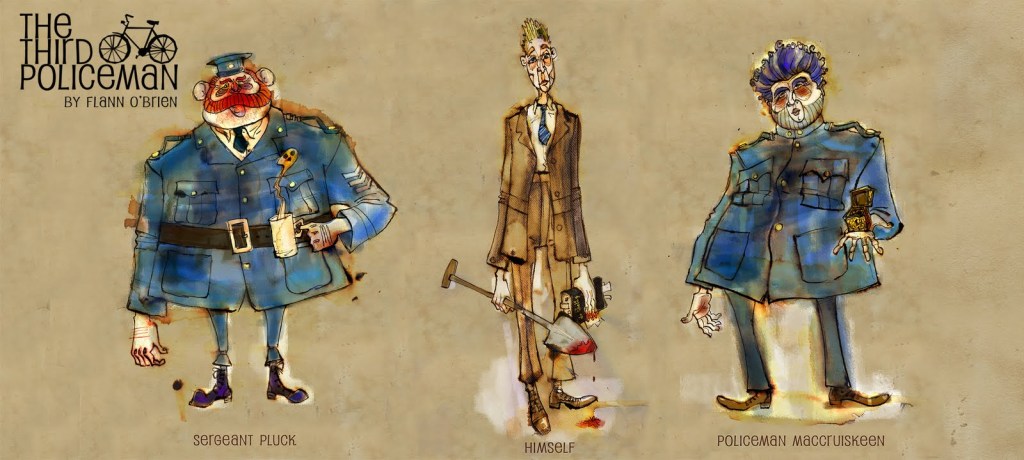
- Author: Flann O’ Brian
- Title: The Third Policeman
- Published: 1967
- List Reading Challenges 2018
- Monthly reading planning
Introduction:
- The unnamed narrator of The Third Policeman is
- …obsessed with the bizarre philosopher De Selby.
- In in order to publish a book about De Selby
- …the narrator agrees to murder a man for his money.
- However, the narrator’s partner in turn murders the narrator.
- Then the narrator is thrust into a bizarre journey through the afterlife.
- It was a wild and at times incomprehensible roller-coaster ride!
Ch 1-3:
- The novel begins with the narrator’s life.
- recounts the narrator’s whole life and
- the commission of a murder
- narrator dies… murdered by his partner in crime.
- Here’s the clue: neither he nor the reader knows this.
- Luckily I read a synopsis of the story before opening the book
- …so I tried to discover subltle clues
- …that would indicate the narrator is dead.
- I remained #Clueless.
Ch 4-7
- The fourth chapter marks the narrator’s full entry
- …into the afterlife.
- The narrator encounters a police barracks.
- Two policemen are obsessed with bicycles!
- O’Brian mentions bicycles 188x in the book
- …and for the life of me
- …I could not figure out what a bicycle
- was supposed to represent!
- #Frustrating.
Ch 8-12
- The narrator delves further and further into the strange world of the afterlife
- Down a hidden left-hand turn a short distance from the police station
- …there is an underground structure known as eternity.
- Now I really #NeedCoffee.
- The narrator follows the long road underground
- …only to reemerge into the world and
- …find out that he’s been dead sixteen years.
- Shocked….the narrator returns to the afterlife to restart the cycle.
Conclusion:
- I usually don’t explain the plot of a book
- …in this case I made an exception.
- If you decide to read this book….think twice.
- A piece of literature does have merit
- …even though it does not manage
- …to reach the common reader…like me.
- I did not enjoy the book, although there are
- ..many people who believe O’ Brian’s is an important
- …post modern Irish writer of the 20th C.
- O’ Brian wrote The Third Policeman in 1939-1940.
- O’ Brian was a morose drunk who led an
- …uneventful life as a civil servant in Dublin.
- He showed initial promise in that career
- …but the drink gradually sapped his enthusiasm.
- After reading this book I wondered if O’ Brian wrote
- while in the throes of whiskey.
- His mind must have been ‘expanded’ to develop many strange concepts.
- At times it is baffling
- ….and I tried so hard to appreciate it.
- Flann O’ Brian never found a publisher for this book
- …always rejected.
- After plodding through the book
- …I can see why a literary agent decided
- …it would not become a commercial success.
- Surprise, we are still reading it after 78 years!
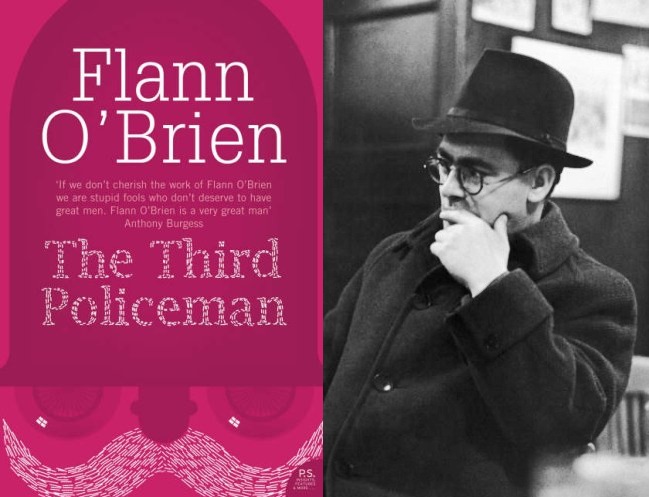
Alice Trilogy by Tom Murphy

- Author: Tom Murphy (1935-2018)
- Title: Alice Trilogy (play)
- Published: 2005
- Trivia: premiered Royal Court, London, November 2005
- List Reading Challenges 2018
- Monthly reading planning
- T. Murphy died on 15 May 2018 (obituary)
Introduction:
- Tom Murphy grew up in Tuam, County Galway, a tough frontier town.
- The youngest of 10 children, he saw his family “wiped out” by emigration.
- He was religious as a child, but had faith beaten out of him by the Christian Brothers.
- “The repressiveness of the Catholic upbringing was extreme,” he shivers
Structure:
Tom Murphy thought is would be interesting to ‘paint ‘ 3 portraits of Alice.
Each portrait is independent of each other in terms of drama.
Act 1 does not dictate how events will happen in Act II or Act III
Timeline: 25 years.
Alice:
is 25 yr – 40 yr – 50 yr.
— trapped by her own personality.
— more depressed with herself more
— than by her husband, family or anybody else.
Portraits:
In the Apiary:
1980 first scene: in the afternoon we meet. Is Alice losing her grip on reality? She he is 25 years old and communing with her alter ego in a dusty attic.
Stage directions: Murphy compares Alice soft-shoed…darting around the attic. She finally stopping at a familiar place….like a rat! She takes 2 pills… like a rat pushing them as a grain of corn into her mouth.
By the Gasworks Wall:
1995 second scene: Alice has summoned a lost love, Jimmy, to meet her by the gasworks wall. Alice is now 40 years old and wants to meet up with a former lover. Like Alice, he is outwardly successful. Jimmy is serious about ‘connecting’…Alice admits she is just fantasizing and wants from here on in just reality. Jimmy feels a fool…walks off. Alice is shaken and retires into the shadows.
At the Airport:
2005 third scene: At the airport… Alice is a 50-year-old woman sitting in an airport restaurant talking to herself while her rich husband silently eats. Alice is estranged from her grown-up children. Alice just rambles on and on about nothing.
Conclusion:
- Playwrights want to ‘move’ the audience
- They want to create stories that generate an emotional response.
- I’m sorry to say….Tom Murphy failed and left me cold
- …and feeling nothing for dear Alice.
- Absolutely nothing….
- So when you get lemons….just make lemonade and
- …asked myself the question:
- Why do people stay in marriages that are going nowhere?
After reading about two different women I thought I’d try to
compare Alice in Alice Trilogy with Stella in Midwinter Break. - Fear of being alone
Alice fears being alone.
Stella longs for solitude. - Lacks courage to change their lives
Alice cannot face up to change…the years will just drag on.
Alice is not pro-active
Alice knows what she needs to do to be fulfilled
….but she can’t do it. - Stella wants to make something of the years she has left
Stella is pro-active
Stella knows what she needs to do to be fulfilled
….and she CAN do it. - Fear of not being loved or accepted by anyone else
Alice was in a loveless marriage but could not escape.
Stella was in a marriage filled with love…but did not want to stay. - Financial problems
Alice is materialistic and very dependent on her indecently rich husband
Stella is spiritualistic and is not concerned about financial matters.
‘All my life I’ve been putting cornflakes on the table […] the daily grind’.
‘I want to live a more devout life.”
#NotAMustRead
#Read Ireland Dermot Healy

- Author: Dermot Healy (1947 – 2014)
- Title : The Collected Short Stories
- Published: 2015
- Story: The Island and the Calves
- List Reading Challenges 2018
- Monthly reading planning
- Reading Ireland Month
- Masterpost 746 Books (Cathy)
- #readireland18
- #begorrathon18
- #DealMeIn2018 Bibliophilopolis
Who was Dermot Healy?
- He was one of the most distinctive voices in recent fiction and poetry
- – not just Irish fiction and poetry.
- He once said of Franz Kafka, one of his abiding influences:
- “He taught me a lot about the normal and the abnormal,
- …and the distance between them.
- Contemporary Irish fiction…think of Dermot Healy
- His writing reflects the fine line between what appears and
- …as Healy said: “What I think is there.”
The Island and the Calves
- Jim: (Irish)
- “Jim felt he might lose control of each and every moment.
- “….every turbulence of wind ad rain had deepened
- the reflections in the now calm lake.
- He had begon to name with awe each part of the outside world…”
- Edward: (English)
- Job 6:7 ” The things that my soul refused to touch
- …are as my sorrowful meat.” (are loathsome to me) (pg 19)
- Dermot describes an Easter weekend in Sussex
- …as Edward is visiting his friend Jim and his wife (Margaret) and their children.
- Jim and Edward have been friends for a long time.
- Jim delights in nature, “Edward will not listen or look at the trees and water.”
- One thing Jim and Edward do share deeply is a
- appreciation of the spiritual/religious world.
- They enjoy Haydn’s ‘The Seven Last Words of Jesus Christ on the Cross (music).
- They set up an antenne to pick up the Mass in Irish from Raio Éireann
- to allow the chants from Jim’s home country permeate the house.
- Motif: Dermot Healy uses the winds as points on a compass.
- The winds channel in a low hum that sparks reflection.
- The winds blow…
- from the east (general sheet of cold),
- from the south (softened and warmed) and
- from the west (passion departs and reason returns).
- Moral:
- The sorrowful day (Holy Saturday) is followed by the joyous (Easter Sunday)
- …”when man’s heart might take that agile journey
- towards discovering anew
- ..still points on that compass held firm” (pg 23)
Conclusion:
- Dermot Healy is truly a talented writer
- …that has fallen between the cracks.
- I had to read this story (6 pages) at least four times.
- Healy describes Jim who is haunted by a sense of instability.
- Jim finds a sense of moral strength in nature
- …where the winds blow
- …North – East – South and West during an Easter weekend.
- Edward is the foil.
- The foil moves the more important character
- …to react in ways the
- …might not have found expression without such opposition!
- Jim is more fully revealed to the reader and to himself.
- The principle of continuity:
- Calves will find shelter from the storm and
- fodder from the farmers.
- Geese will always emigrate in winter.
- The hare with “long girl’s thighs and legs”
- will always make a joyous…fling around the apple trees.
- This flow in nature extends into the spiritual world.
#Read Ireland Two Pints (play)

- Author: R. Doyle
- Title: Two Pints
- Published: 2014
- List Reading Challenges 2018
- Monthly reading planning
- Reading Ireland Month
- Masterpost 746 Books (Cathy)
- #readireland18
- #begorrathon18
Conclusion:
- It took me 1,5 hrs and 2 Heinekens to read this play.
- Two Irish barflys…just shootin’ the breeze.
- For instance:
- “Nelson Mandela, he’d never should have left the Four Tops'”
- I haven’t laughed this much in years!
- The last chapter 25-6-14 was on of the best
- …but all the chapters are terrific!
- “Yeh have to admire Suarez, all the same.
- -Go on — why?
- -Well, if yeh were goin’ to bite an Italian–
- […] but He bit a f##kin’ Serb.
- –a f##kin warlord!”
- Last thought: #MustRead

#Read Ireland Patrick Kavanagh (poem)
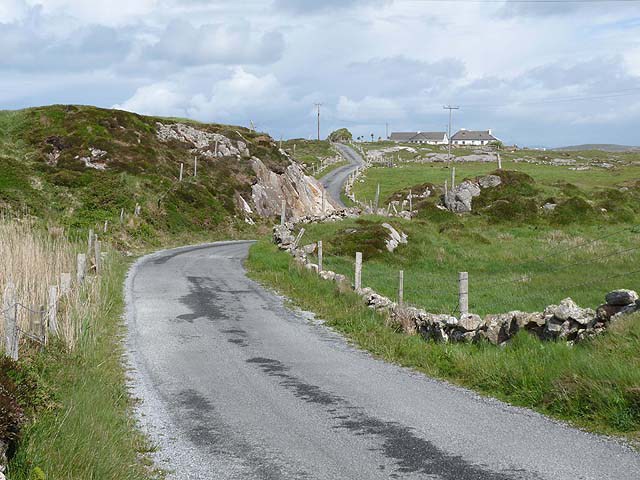
Writer: Patrick Kavanagh (1904-1967)
Poem: Inniskeen Road: July Evening
Published: 1929-1938
- List Reading Challenges 2018
- Monthly reading planning
- Reading Ireland Month
- Masterpost 746 Books (Cathy)
- #readireland18
- #begorrathon18
Notes: Kavanaugh uses the structure of an English Sonnet
14 lines
structure: 3 quatrains (4 lines) and couplet (2 lines)
rhyme pattern: abab-cdcd-efef-gg
9th line: the ‘volta’ or turn indicates a change in tone, mood
Couplet: summarizes the theme
- Inniskeen Road: July Evening
- …it is a love poem to a place .
- The title contains the name of place and time.
- This is which all-important in the world of Kavanagh.
- Inniskeen is the poet’s birthplace and home for more than 30 years.
- These are the contrasts in first stanza.
- First four lines: Billy Brennan’s barn dance is bubbling with life.
- Second four lines: the roads are silent.…everyone is at the dance.
- These are the similarities in second stanza.
- Selkirk ‘ knew the plight of being king …”
- Selkirk is king of his island
- Kavanagh is king of Inniskeen Road.
- Alexander Selkirk was a famous Scottish
- Royal Navy officier.
- He spent 4 yrs a castaway on a South Pacific Island!!
- Kavanaugh likens his loneliness
- on Inniskeen Rodad to that of Selkirk on the island.
- Solitude:
- — solitude of the ROAD — solitude of the POET.
Poem: Inniskeen Road: July Evening
The bicycles go by in twos and threes -
There's a dance in Billy Brennan's barn tonight,
And there's the half-talk code of mysteries
And the wink-and-elbow language of delight.
Half-past eight and there is not a spot
Upon a mile of road, no shadow thrown
That might turn out a man or woman, not
A footfall tapping secrecies of stone.

I have what every poet hates in spite         [9th line = change of mood]
Of all the solemn talk of contemplation.
Oh, Alexander Selkirk knew the plight
Of being king and government and nation.      [= loneliness]
A road, a mile of kingdom. I am king          [Couplet}
Of banks and stones and every blooming thing.
Mapping Irish Theatre
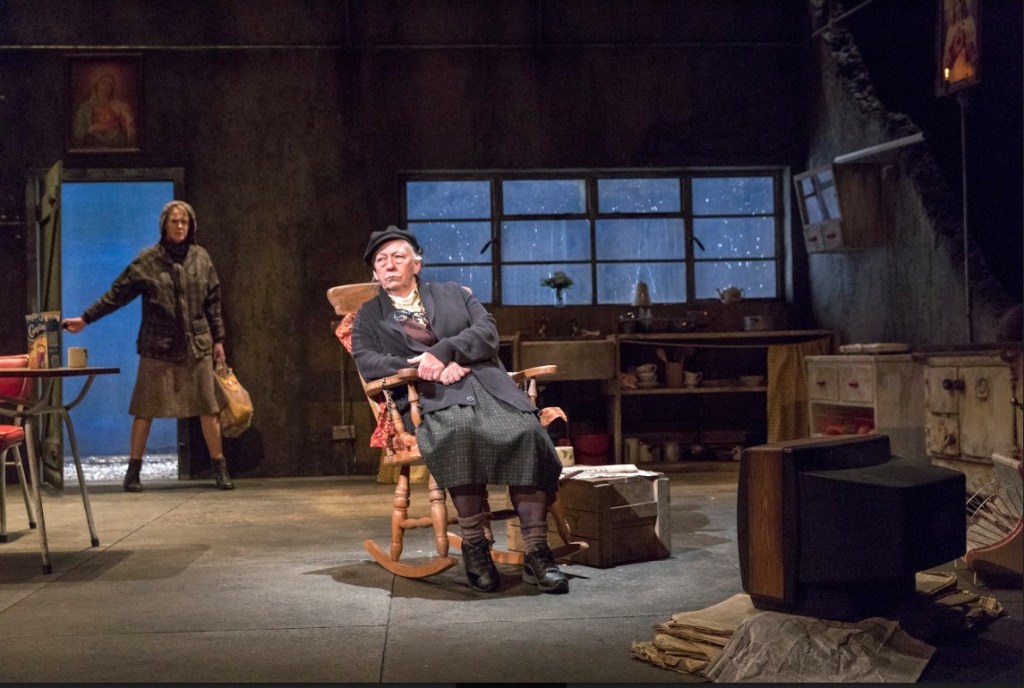
Irish cottage (or kitchen)….is often the setting of Irish plays!
Writer : Chris Morash, Shaun Richards
Title: Mapping Irish Theatre (175 pg)
Published: 2013
- List Reading Challenges 2018
- Monthly reading planning
- Reading Ireland Month
- Masterpost 746 Books (Cathy)
- #readireland18
- #begorrathon18
- #NonFicReads18 Doing Dewey (Katie)
Who is Chris Morash?
- Professor Chris Morash is the first
- Professor of Irish Writing
- …in Heaney’s name at Trinity College.
- This appointment is permanent.
- The professorship was announced shortly before Seamus Heaney’s death.
- Dr Morash is originally from Nova Scotia, Canada
- …with no Irish connection.
- He came to Ireland in 1985 to study Irish writing in Trinity.
What is theatre?
- Seamus Heaney put it very simply:
- …theatre is a machine for making place from space.
- Mapping Irish Theatre examines the
- …relationship between a society and its theatre.
- Irish plays are deeply entrenched sense of place.
- Place in Irish theatre involves a particular set of
- …relations to memory, loss and nostalgia.
What did I learn? (…essential to understand if you read this book!)
Three forms of space:
- perceived -to be aware of directly through any of the senses
- conceived –to form or develop in the mind
- lived – to be experienced between the performers and audience
- Space is different from performance to performance.
- Space is different through historical periods.
- Example: I just read Tartuffe.
- It was performed 1669.
- But Chris Hampton’s translation and adaptation
- ..that is to open in May 2018 in London
- …will be very different.
- Elements of language, dialogue, scenery
- …will change over time.
Theatre space:
- It is an unspoken element of the text
- a zone filled with gaps where
- … gestures and movements unfold.
What was the most difficult issue to understand? Theatre signals
- The stage radically transforms all objects.
- These objects have a signifying power which
- …they lack in their normal social function.
- All that is on stage is a sign.
- Door = theatrical signal
- For instance in a play…..we see a door.
- It is not only means of entering and leaving the stage.
- It is the focus point.
- Behind it is an imagined offstage world
- …that is just as important as the dramatic action on the stage!
What was the best part of the book? I discovered so many types of plays!
- Padraic Colum’s The Fiddler’s House (1907)
- …stranger-in-the-house
- Brian Friel’s Dancing at Lughnasa (1990)
- ….(cottage) kitchen the kitchen- and- sink- play.
- Conor McPherson’s The Weir (1997) a pastoral play
- …our outside concerns are suspended so that an
- act of inner healing to be achieved
- Tom Murphy’s Famine (1977) historical outcome (unknown to characters)
- …but glaringly self-evident to us….famine/depopulation hangs like a cloud.
- Brian Friel’s Freedom of the City (1973) past-in-the-presemt play
- Characters are simultaneously dead and
- …present before the audience!
What will I do now when reading a play…that I didn’t do before?
- Note: notice the first lines of plays….what do they refer to?
- Note: what is implied as happening or a place ‘offstage’ ?
- Note: what is the conflict between offstage vs on-stage?
- Note: important objects on stage…( first character we meet in
- …Dancing at Lughnasa is is Marconi…the radio!
- Note: space on the stage: is it familiar to the characters?
- …home kitchen in The Aran Islands (Synge)
- …exiles in an abandoned church in Sanctuary Lamp (1975) T. Murphy
- The characters have to learn about the space along with the audience.
Conclusion:
- This was a very academic read.
- Example:
- Difficult way of saying things…!
- Morash: Play produced dialogically…
- Nancy: ….in other words …written in dialogue.
- How else are you supposed to write a play? (pg 115)
- It took me 3 days to read the book and my
- determination paid off.
- I never realized that a play is MUCH more
- …than a script and actors!
- Chapters 2-3-4-5 were the best.
- Morash explains in more detail specific Irish plays and
- …that was what I was looking for!
- The central to the craft of play-writing (Irish)
- …is the shaping of experience into scenes.
- Opening of a play and starting to read it
- … is like going to a party where you don’t know anyone.
- Characters unfold in time and
- …first impressions will be modified by later ones!
- #TimeToReadIrishPlay

Chris Morash
Did you know there are 3 types of theater spaces?
Arena – audience surrounds the actors

Thrust – audience is positioned on 3 sides of the stage ( Ancient Greece)
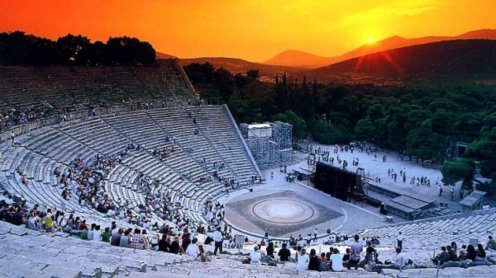
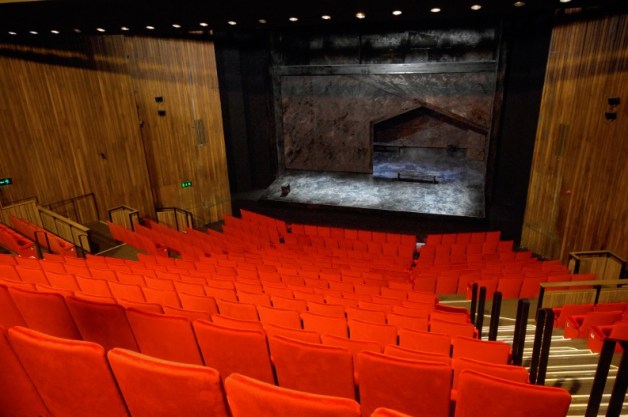
Proscenium – the arc of the stage seperates the actors from the audience

The Abbey Theatre Dublin:
- The theatre first opened its doors to the public
- …over a hundred years ago, back in 1904.
- The original building was damaged by fire in 1951 and
- the Abbey had to be re-located but still remained active.
- The theatre offers a unique sound experience
- due to its wooden pallets, which are
- not obtainable anymore and can only be
- found in a few remaining locations worldwide.
- The Abbey holds 394 seats, that all share the same view.
- The idea was to get rid of the social hierarchy and
- guarantee every audience member the same experience.
#Read Ireland Midwinter Break

- Author: Bernard MacLaverty
- Title: Midwinter Break (242 pages)
- Published: 2017
- Trivia: Nominated for Wellcome Prize
- Trivia: Irish Books 2017 – Irish Times Critics Choices
- List Reading Challenges 2018
- Monthly reading planning
- Reading Ireland Month
- Masterpost 746 Books (Cathy)
- #readireland18
- #begorrathon18
Introduction:
- This is a portrait of a marriage in the twilight years.
- During a long weekend in Amsterdam a couple
- …step back from their ‘married life’
- …and concentrate on what really matters.
- For her: prayer was like a visitation,
- …like checking her child in the light from the landing,
- …last thing at night.
- For him: a dram of whiskey and a drop of water
- …last thing at night.
- How could changes be made at their age?
Conclusion:
- MacLaverty writes a very touching story.
- Two people Gerry and Stella have been married for years.
- I’m sure the reader feels at some point
- ….what Stella is going through
- ….especially if the reader has been married for many years.
- You’ve reached the point when
- ….your partner’s habits begin to ‘grate’ !
- The couple visits Amsterdam
- ..and I could envisage the exact places they were visiting.
- This book was an entertaining quick read
- ….with a cup of tea and some chocolate.
#Read Ireland Kevin Barry
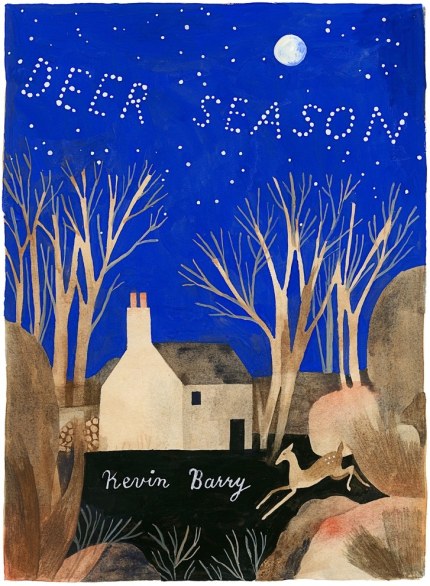
Writer : Kevin Barry
Title short story: Deer Season
Published: The New Yorker, October 10 2016
Theme: Guilt (breaking the law); feeling of isolation
Setting: Province of Connacht, Ballymote, Co. Silgo
Timeline: 5 days in August…then the story ends in October
- List Reading Challenges 2018
- Monthly reading planning
- Reading Ireland Month
- Masterpost 746 Books (Cathy)
- #readireland18
- #begorrathon18
- #DealMeIn2018 Jay’s Bibliophilopolis
Who is Kevin Barry?
- Kevin Barry’s debut story collection, There Are Little Kingdoms,
- won the Rooney Prize for Literature in 2007.
- His short fiction has appeared most recently in The New Yorker.
- His novel, City of Bohane, was published in
- 2011 and won International Dublin Literary Award 2013.
Title: Deer Season
- At the end of the story the reader
- …can see the similarities between
- …a young deer and Edward.
- He is frightened of what is to
- …become of him in the neighborhood.
- He feels hunted.
Structure:
- Paragraphs: (26)
- Dialogue: 61 short lines of dialogue
- young girl (remains nameless) Edward and her father.
Characters:
- Young nameless schoolgirl (17)
- She wore a cardigan – a gray
- …might seem a little nunly.
- “She declares herself a Romantic and
- …bare winter was her idyll.”
- Edward (35 )…with scruffy hair
- …rents cottage in the forest.
- His bungalow is filled with
- disheartening musk of adult maleness
- ...there was something military about the neatness.
- He had the hunted look of rural poverty.
- His clothes were not good,
- …army surplus with ugly stout boots.
- Edward stepping carefully about…
- like a heron.
- Backround information:
- Her father is on the farm
- …her mother is dead and
- …she has en older brother William.
Plot:
- This adventure start out… .
- She purposely attracts a young man for
- …her clever idea of a summer fling.
- She didn’t have any great desire for the man,
- …but she liked his voice and he wasn’t fat.
- It was just a fun thing to do.
- But this summer fling has dire consequences
- …for vulnerable Edward (35 yr)
- He is a loner and feels…..just this once.
- He shall probably never have another chance.
Tone: Gothic
- October dark fell.
- The night folded into quiet of its soft enclosure.
- It was moonless and the great dark pressed in.
- The chill from the river,
- …fingers of mist, a dampness rose.
- The last remnants of light
- …clawed in weak scratches across the sky.
- She walked beneath a cloak of widowly despair.
Setting:
- Edwards house was clean, tidy, reeked of animal want
- …damp pebble-dash bungalow (exterior wall finish).
- Misery essayed everywhere.
- There were lentils soaking on the draining board
- …he tired to scrub tea mug with index finger under the running tap.
Strong point: closure
- This adventure starts out…
- with the girl touching Edward:
- “...pads of her fingertip touch
- …his skinny biceps – like a dog’s muscle, twitched madly”
- Kevin Barry bookends the story with…
- “She made for home and the pads of her feet beat
- out the new soft rhythm of her power.
- She was stiff from the cold and felt many years older.”
Conclusion:
- Kevin Barry…could be the
- new Irish short story writer
- I’ve been looking for!
- This was an absolutely wonderful story
- with and under tone of tragedy
- …and loss of innocence.
- The young girl does not know
- the ‘weight’ of her sensual powers
- ….until she gets the freedom to use them.
- #MustRead Irish author
#Play The Weir

Playwright: Conor McPherson (1971)
Title: The Weir (1997)
Theme: loneliness. Setting: pub in isolated town western Ireland
Trivia: The Weir won Laurence Olivier Award for Best New Play 1997.
Trivia: The Weir was voted one of the 100 most significant plays in 20th C
Genre: The Weir is a pastoral play. It gives the reader a slice of rural Irish life.
McPherson wants to contrast the country vs the city. …the actual vs the mythical storytelling.
- List Reading Challenges 2018
- Monthly reading planning
- Reading Ireland Month
- Masterpost 746 Books (Cathy)
- #readireland18
- #begorrathon18
Analysis:
1. Explain the title. The Weir In what way is it suitable to the story?
a. OLD – The weir is a barrier whose function originally was a fence made of sticks or wattles built across streams or rivers that trap fish. It acts as a sieve.
b. NEW – The weir refers to a local dam built in 1951 to regulate water and generate power. c. The title is suitable as a symbol between the contrasts in the play: old vs modern; world of folklore vs contemporary life; between agricultural tradition vs 20th C modern development.
2. What is the predominant element in the story? Characters
Jack: garage owner, 50’s
Brendan: the owner of the pub 30’s (only listens, no story to tell)
Jim: garage assistant, 40’s
Finbar Mack: a local businessman late 40’s
Valerie: a Dublin woman 30.
3. Who is the single main character about whom the story centers?
Jack: is the main character. He undergoes the greatest change.
b. He is the talkative leader of the barflys, ‘old-school’ Irish,
c. devoted to the national beverage of Guinness.
d. Finbar: (foil for Jack) ‘get rich quick’ Irish real estate man, flashy, content to drink
e. the ‘last beer anyone would choose’ bottled Harp.
f. Valerie: incomer; city folk, drinks white wine; Brendan is flustered….Wine?
g. He finally finds a bottle he received as a gift.
h. When pouring her glass he fills it up as he would a pint.
4. How does the story get started?
The play opens on a stormy night in Brendan’s pub.
b. A rural Irish pub is located in an isolated town in County Leitrim.
c. Brendan, the owner of the pub, opens the bar, fills the till and checks the beer taps.
d. Jack and Jim (his regulars) are gathering for their daily pint.
5. Briefly describe the rising action of the story.
The action in the play is very subtle. The arrival of a stranger from Dublin city, a beautiful woman (Valerie). She has just rented an old house in the area.
The barflys want to impress her or perhaps scare her off (?) …with eerie stories about souls past, spirits present, ghosts and …half-haunted encounters. It is an authentic night drinking with locals who have the gift of blarney.
6. What is the high point, or climax, of the story?
a. 4: Valerie’s true story…(read the play and discover this for yourself!)
7. Discuss the falling action or close of the story.
After Valerie’s story the mood changes.
Jack’s talk with Brendan and Valerie is the last…..it is a confession.
McPherson bookends the play.
Brendan closes the bar.
a. Weak point: no real conflict. Play writing is all about conflict. The power of the play derives from the power of argument in the dialogue. In this play all I could find were a few verbal jabs about horseracing betting tips.
b. Weak point: I was looking for the ‘lilt of Irish humor, the…capacity to make rapid and irresistible remarks. In this play I only chuckled twice: at the beginning (defect beer tap) and at the end (who are the Germans, really?)
c. Weak point: play contains 3 ghost stories barflys tell each other that were not scary.
d. Weak point: This play does not come to life on paper. It….MUST have actors to relate the emotions in the dialogue. I read the play twice before making a conclusion. I wanted to see if I missed something.
Conclusion:
- This was my first one-act play. It should be tightly compressed, short,
- with playing time max forty-five minutes.
- A single setting (pub) should be a ‘pressure-cooker play‘.
- The energy should build up, ready to blow off the pan’s cover.
- This play is ninety minutes long on stage.
- The play felt like it was quietly simmering on the back-burner.
- The only way to really enjoy the play is to see a stage performance.
- Playwright’s task is to create stories that generate emotional responses.
- I felt nothing.
- Some local color with expressions as yous , jays, and jayus.
- ..do not a great play make.
- Why did this play win Laurence Olivier Award for Best New Play 1997?
- I am #Clueless.

Conor McPherson
Reading Ireland Wrap-up 2018

- Read Ireland Month 2018!
- Masterpost 746 Books (Cathy)
- No one can tell a story like an Irishman!
- #readireland18
- #begorrathon18
My reading list:
- Midwinter Break – B. MacLaverty – READ
- Wounds – F. Keane (non-fiction) – READING
- Mapping Irish Theatre – C. Morash (non-fiction) – READ
- The Third Policeman – Flann O’ Brian – READING
- A Long Long Way – S. Barry – READ
- Poem: Innskeen Road: July Evening – P. Kavanagh – READ
- Poem: The Bluebells are Withered – P. Kavanagh – READING
- Poem: The Lost Limb – D. Healy – READING
- Essay – The Poetry P. Kavanagh – S. Heaney – READING
- Poet: P. Kavanagh – READING
- Short Story: Memories of Youghal – W. Trevor – READING
- Short Story: Home – C. Finn – READING
- Short Story: Deer Season – K. Barry
- Play: The Weir – C. McPherson – READ
- Play: Alice Trilogy – T. Murphy – READING
- Play: St. Joan – G.B. Shaw
- Play: Famine – T. Murphy
- Seamus Heany – H. Vendler- READING
 NancyElin.blog