

#Paris In July “Le Grand Meaulnes”
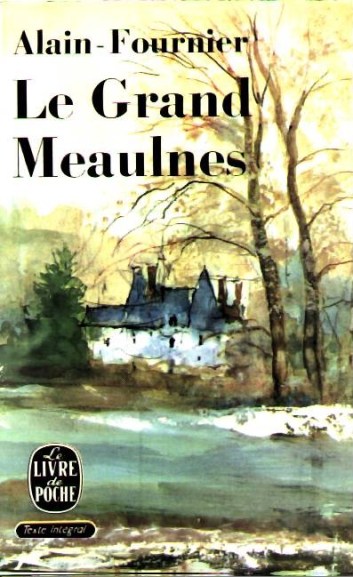
Author: Alain-Fournier (1886 – 1914)
Title: Le Grand Meaulnes
Published: 1913
Contents: 200 pages (3 parts)
Language: French
Trivia: Le Grand Meaulnes was shortlisted for Prix Goncourt 1913 but lost by 1 vote.
Trivia: Today the book is nr 9 on Le Monde’s list 100 best books of 20th C.
Trivia: …and the Prix Goncourt winner “Le peuple de la mer’ has been long forgotten!
Available in English “The Lost Estate”
Introduction:
- Le Grand Meaulnes is the only novel by French author Alain-Fournier.
- Fifteen-year-old François Seurel narrates the story of
- his relationship with seventeen-year-old Augustin Meaulnes
- as Meaulnes searches for his lost love.
- Impulsive, reckless and heroic,
- Meaulnes embodies the romantic ideal,
- the search for the unobtainable, and
- the mysterious world between childhood and adulthood.
ANALYSIS:
1. Explain the title. In what way is it suitable to the story?
Augustin Meaulnes, called ‘Le Grand Meaulnes’ fascinates the students with his mysterious personality.
2. What is the predominant element in the story?
Setting: (estate) The setting is the central focus of the book . The village of Sologne and its school, the mysterious ‘domain’/chateau with the surrounding paths , ponds, slopes, reeds, marshes. The characters are running away from the village school (Augustin), running away from the ‘domaine’ (Frantz), running away from village where young Yvonne waits for her new husband (Augustin).
3. Who is the single main character about. whom the story centers?
Main character is Augstin Meaulnes.
There are friendships: Augustin/François and Augustin/Frantz
There are loves: Augustin/Yvonne – Frantz/Valentine – François/Yvonne
4. What sort of conflict confronts the leading character or characters?
a. External – Augustin discovers an ‘enchanted forest’ meets a ‘princess’ (Yvonne). They part abruptly.
b. Internal – Augustin moves from childhood to adulthood, but never stops looking for his vanished beloved.
5. How is the conflict resolved?
Frantz: finds his ‘amour absolu’ (Valentine)
Augustin: finds his ‘amour libertine’ (Valentine) and ‘amour idéal’ (Yvonne)
François: finds his ‘amour impossilble’ (Yvonne)
7. Who tells the story? What point of view is used?
François is the narrator of the book. His parents are the teachers at Sainte Agathe in Sologne.
8. Where does the primary action take place?
Village of Sologne, Vierzon, Vieux-Nancay
9. How much time does the story cover?
I estimate that the story takes place over 10 years. It begins when Augustin arrives as a boarder with the Seruel family in Sologne. It ends as Augustin returns from a long trip.jaar.
10. How does the story get started? What is the initial incident?
Augustin arrives at the school. His arrival is going to change François’s calm and lonely life.
11. Briefly describe the rising action:
Augustin loses his way during a walk, discovers a beautiful estate, pre-wedding party and the love of his life.
12. What is the high point, or climax, of the story?
The writer uses language to indicate that Meaulnes and the ‘bohémien’ finally trust each other: (pg 92)
“Puis cessant d’ employer ce <vous> insolite chez des écoliers de Sainte-Agathe.”
Stop using ‘vous’ …unusual for students
The writer uses a mini-climax at the end of each part to move the story along. Part 1 gunshot in the forest; Part 2 letter from Augustin to François. The main climax in on page 104-105.
The illusions and pantomime disappear. Frantz removes the scarf. We see the scare of his attempted suicide. The tone in the book swings from an enchanted world of youth to harsh word of adulthood. “…enlève son bandeau pour être reonnu de nous.”
13. Discuss the falling action or close of the story.
François, Augustin and Frantz try to put the pieces of their ‘past youth and lost loves’ back together ‘…perhaps everything will be as in earlier times. Can the past return? Who knows! (Mais le passé peut-il renaítre? Qui sait!) (pg 159)
14. Does this story create any special mood?
Alain-Fournier creates through his atmospheric images a feeling of:
nostalgia: – tormented and cherished days ebb and flow against the rocks like waves, our adventures. (pg 11)
eeriness: – you hear the whistles and moans of the shipwrecked in the attic. (pg 164); “un vent noir et glacé soufflait dan le jardin mort” (pg 36)
enchantment: – I’m looking for something very mysterious. This passageway mentioned in books, the ancient hidden path, the one the exhausted prince was too tired to find. (pg111) (..famous quote from the book)
15. Is this story realistic or true to life?
We know that Alain-Fournier grew up far from the sea but had a life long desire to join the navy. The sea was his ideal and he used many nautical images in the book. Mysteriously he changed the little houses in the village of Sologne into ships, boats and sails. On page 57 the author describes men at the festive meal, freshly shaven who could have been ex-sailors. But he tells us they never sailed the seven seas…..only weathered rains and wind while making furrows in the fields and returning home in their carts. These are only a few nautical descriptions of the villages and people where the story takes place.
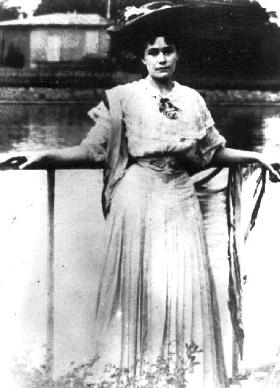
Yvonne de Quiévrecourt was born in 1885 in Paris.
In 1905 Alain Fournier was suddenly faced with the girl of his dreams.
This encounter changed Fournier’s life and provided the basis for Le Grand Meaulnes.
16. What is the structure of the book?
Part 1: (30%) Meaulnes’s arrival and departure in the village Solonge + strange adventure.
Part 2: (22%) Gypsy ‘Frantz’ – Meaulnes’s departure for Paris
Part 3: ( 37%) Wedding – Journal intime – lost happiness
The last chapter which reveals the intrigue, secret and its impact is only 3 pages!
17. What is the general theme of the story?
Adventure and discovery: Meaulnes and Yvonne after their wedding are ready to set out on an adventure. Like two passengers adrift in a boat (nautical image), in the winter wind, two lovers enclosed in happiness. (pg 170)
“Comme deux passagers dans un bateau à la dérive, ils sont dans le grand vent d’hivier, deux amants enfermés avec le bonheur.”
18. Did you identify with any of the characters?
François Seurel: Despite his unwavering loyalty to Augustin, his support of the abandoned Yvonne, his care of a nameless young child….he is left with nothing at the end. In ch1 we read of François’s sad and lonely days in the village. Augustin came and brightened his life. But after losing his best friend and the girl he had secretly fallen in love with (Yvonne) his days were again…sad and lonely.
19. Does this story contain any of the following elements?
Metaphor: sea, boats, sails, anchors, waves used to enhance the theme of an ‘adventure’.
The classroom is like a ship. (pg 23)
The village houses are boats anchored with their sails ready to be unfurled. (pg 142)
Symbol: Meaulnes is Robinson Crusoe on the brink of an adventure.
“Peut-être le gout des aventures plus fort que tout…” (pg 183)
The taste for adventure….stronger than everything.
Meaulnes reminds his young friend of Crusoe in the basket shop. (pg 22)
The title of ch 3 part 1 is a quote from Robinson Crusoe:
“Je fréquentais la boutique d’un cannier” .
Simile: Meaulnes is like a sailor keeping watch at night. (pg 36)
“comme ces marins qui n’ont pas pu se déhabituer defaire le quart…”
He is like a soldier on alert sleeping in his clothes. (pg 35)
“soldat au cantonnement d’ alerte”
All these actions increase the adventurous feeling of the book.
20. Does the story contain a single effect or impression for the reader?
Sadness: François is carrying Yvonne’s dead body. The only time he held her in his arms as the bridegroom he longed to be. “ Je baisse la tête sur la tête de celle que j’emporte, je respire fortement et ses cheveux blonds aspirés m’entrent dans la bouche, ces cheveux morts qui not un goût de terre.”
Translation:
I lowered my head onto the head of the one I was carrying,
I breathed deeply and inhaled her blond hairs into my mouth,
these dead hairs that have a taste of the earth.
Conclusion:
This book is more about rich images than tense action.
Because of author’s poetic style the words seem to float over the pages.
Weak point: part 2 the pantomime, band of roaming gypises….
This was diffcult to place in the narrative. I needed some help to understand why
Alain-Fournier included it. It is a mise-en-abyme, (frame story).
Pierrot struggling to grow up. (keeps falling and speaking in cries and hoots).
This parallels the struggle of the three main characters
…Francois, Augustin and Frantz – moving from youth to adulthood.
This is a very easy book to read, vocabulary is not difficult.
Strong point: I learned some beautiful words and wonderful expressions!
à la cornette! – a mock directed to a nun in reference to her headgear!
#Paris In July Mousse aux éclats de chocolat
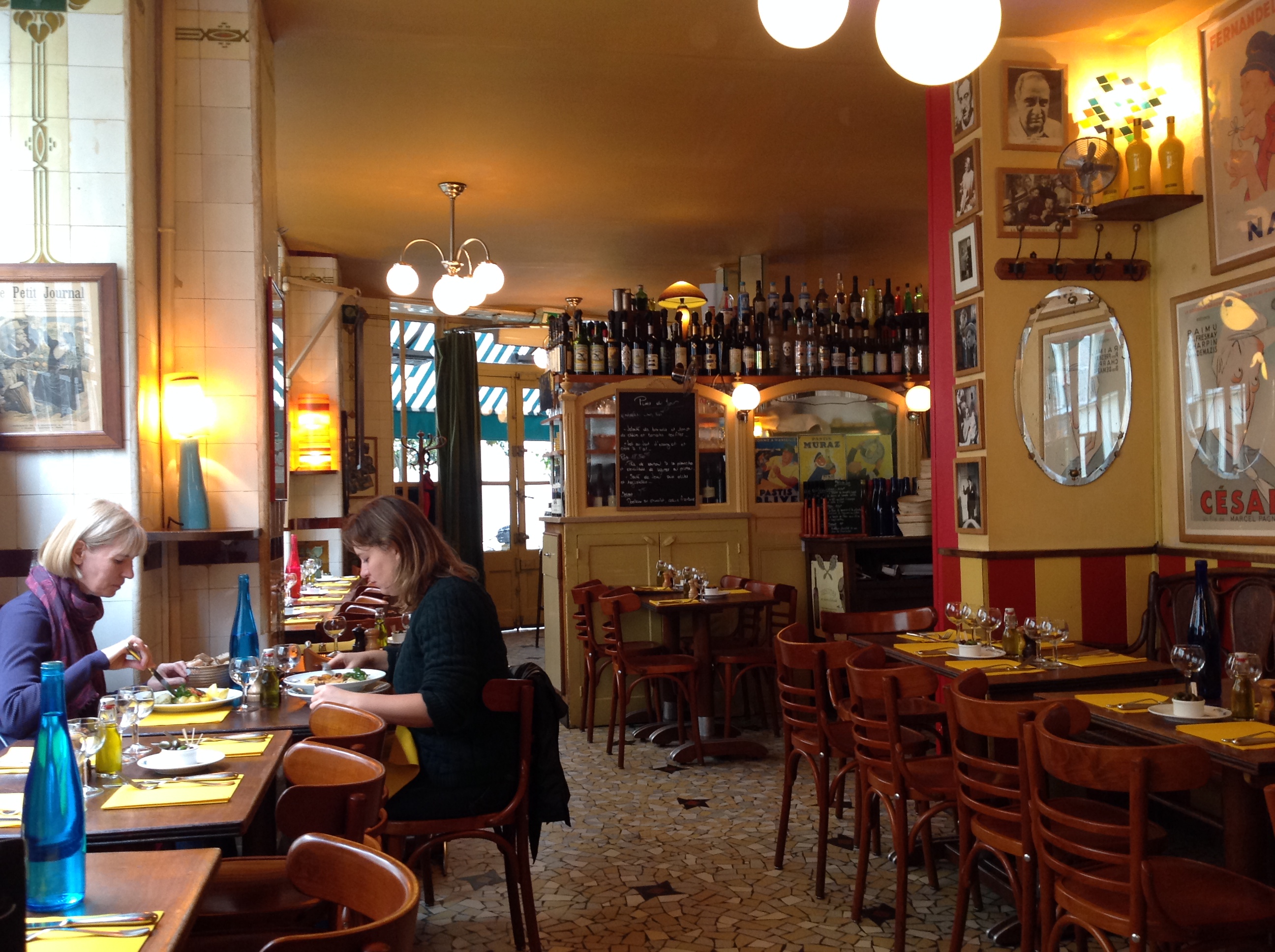
- Time for some bistro food….but this year
- I’m NOT making a main course.
- I have chosen to make a “to die for dessert“
- Mousse au chocolat!
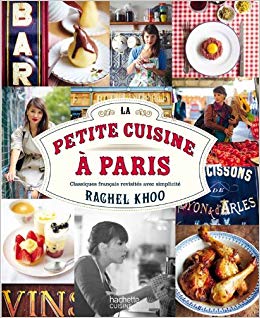
- Cookbook: Petite Cuisine à Paris
- Rachel Khoo
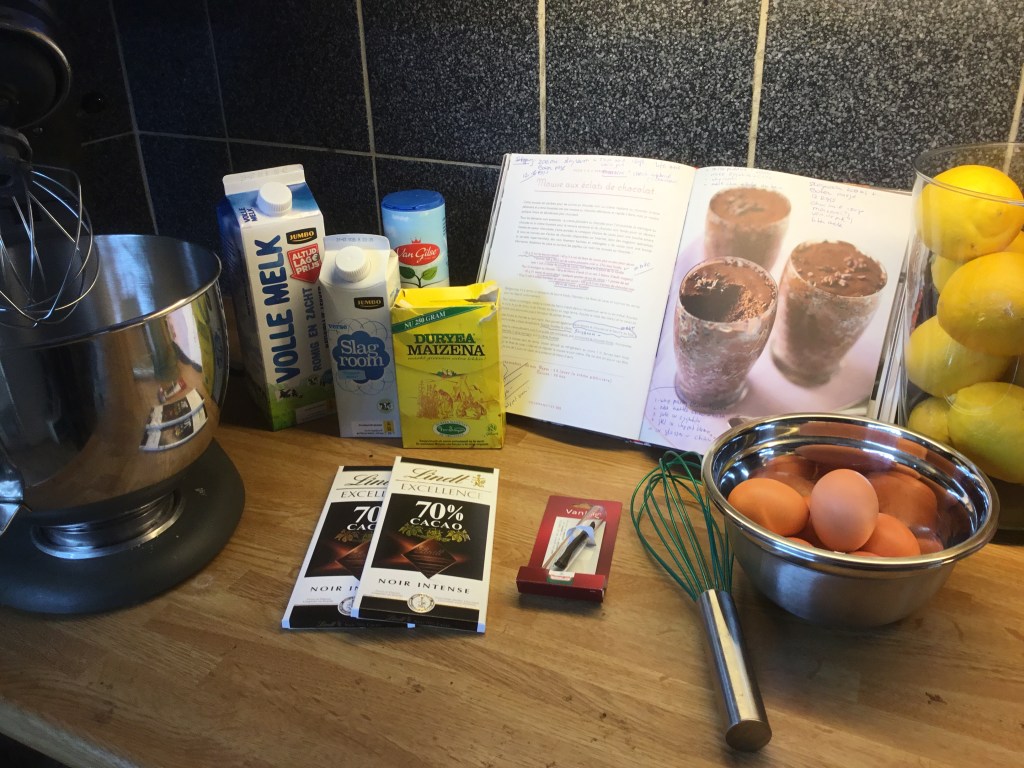
- Crème pâtissière (pg 274)
- Mousse au chocolat (pg 222)
- Note: For more instructions how to share your posts go to Thyme for Tea.
Follow these steps:
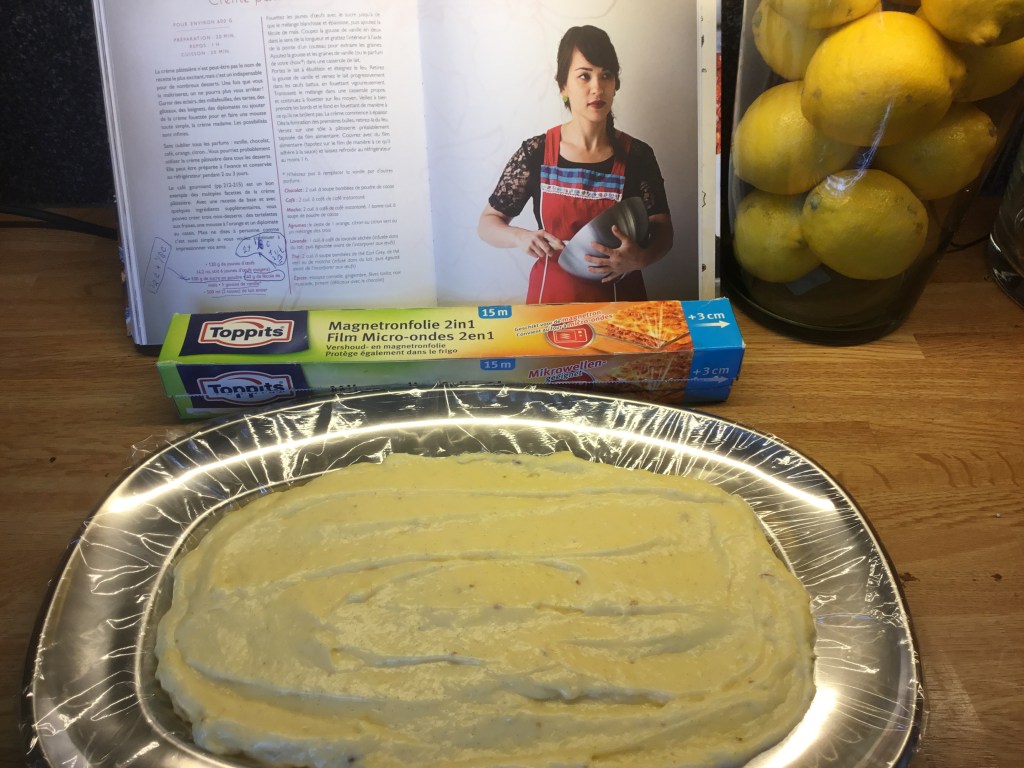
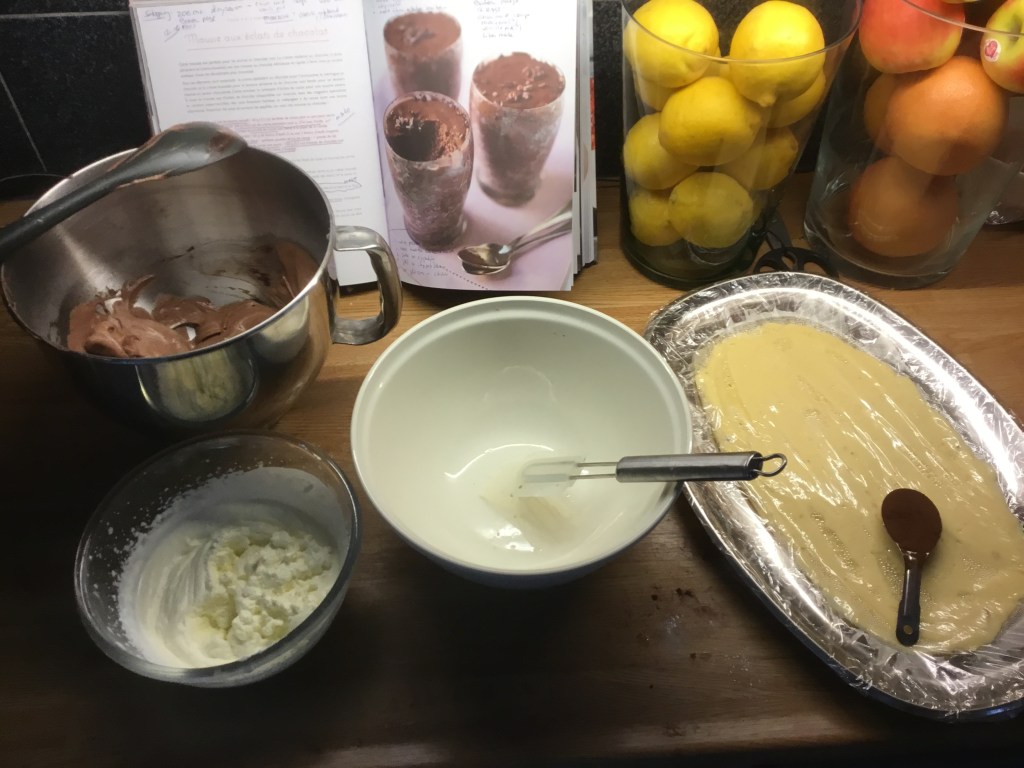
- make crème pâtissère (let cool for one hour in fridge)
- make meringue au chocolat
- (60 gr egg whites, 1/3 c confec sugar, drops lemon juice, dash salt, 1 Tbs cacao)
- melt dark chocolate au bain maire (150 gr)
- whip heavy cream (200 ml)
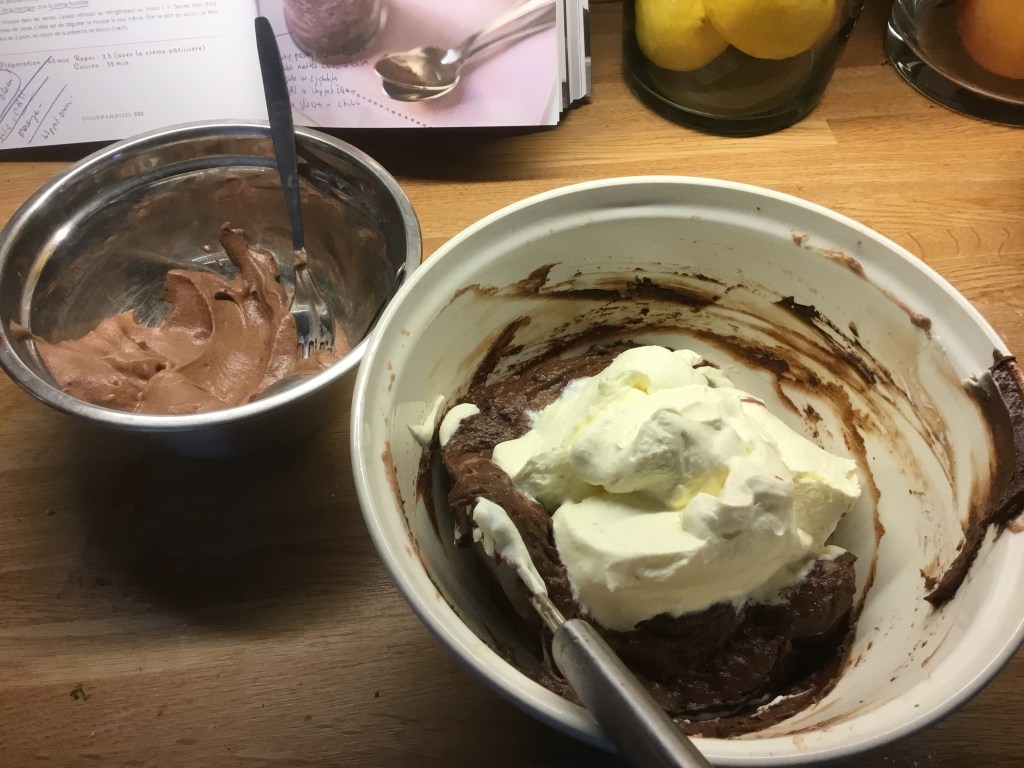
- fold all ingredients together in a large bowl
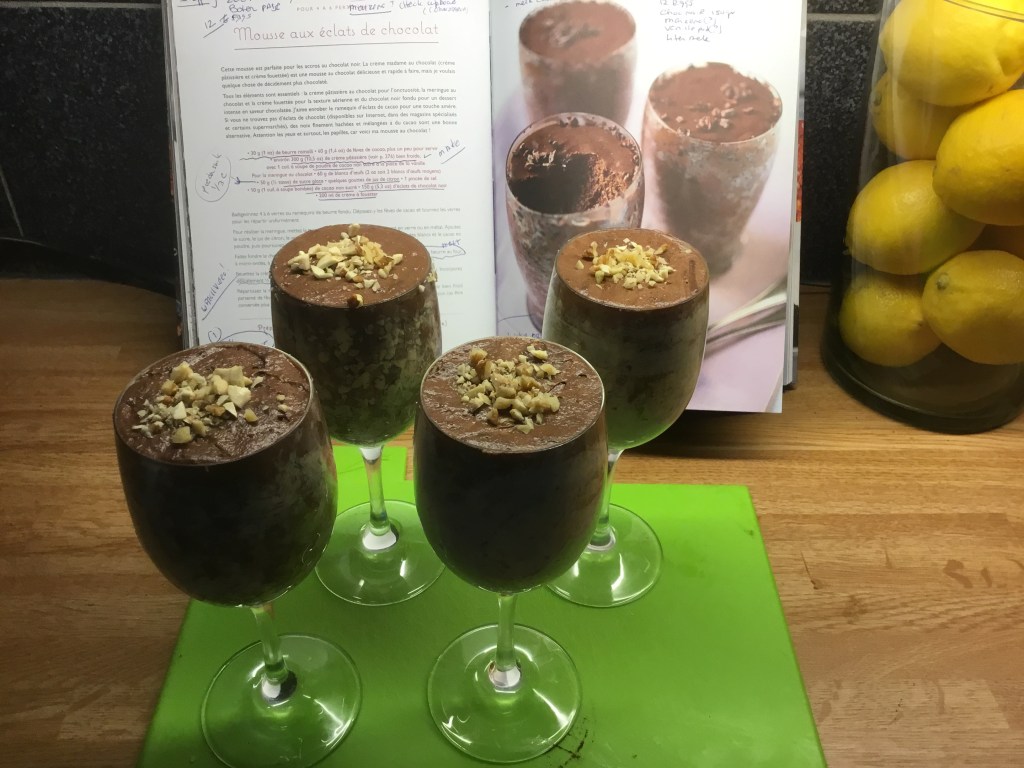
- fill glasses decorated with chopped nuts
- cool in fridge at least 2-4 hours
- Bon Appétit!
Ingredients:
Cool crème pâtissère between sheets of saran wrap...cool for 1 hour
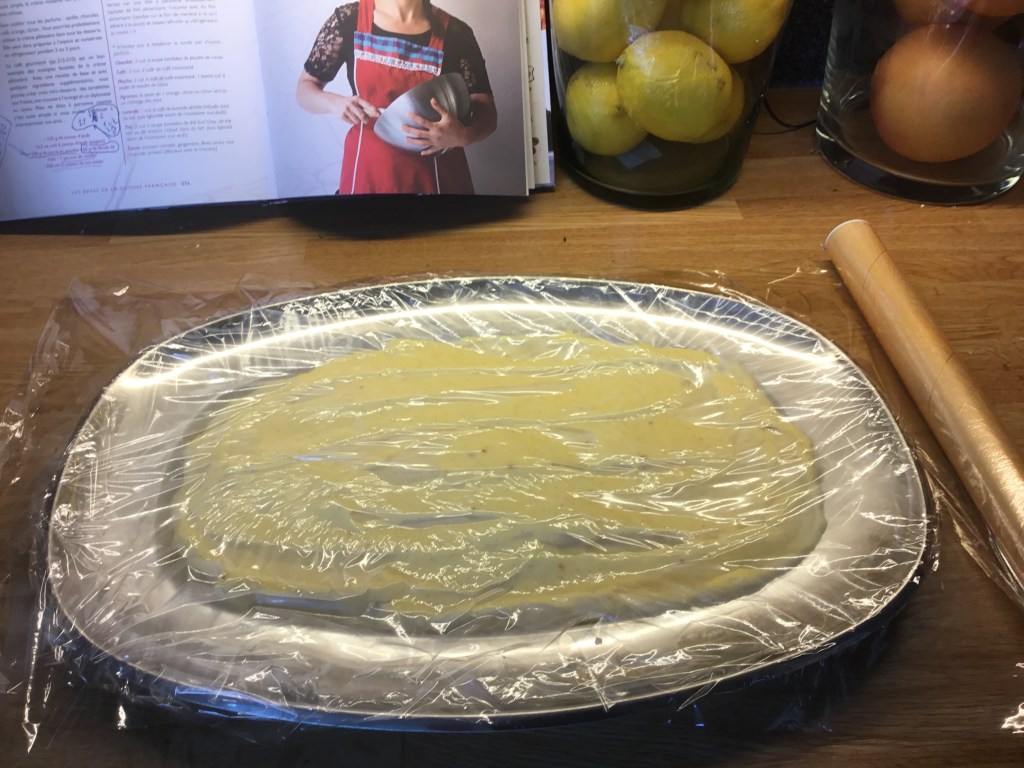
A good chef …..always cleans up her own mess! (…this was the rule in my house growing up!)

Chop nuts to decorate the glasses!

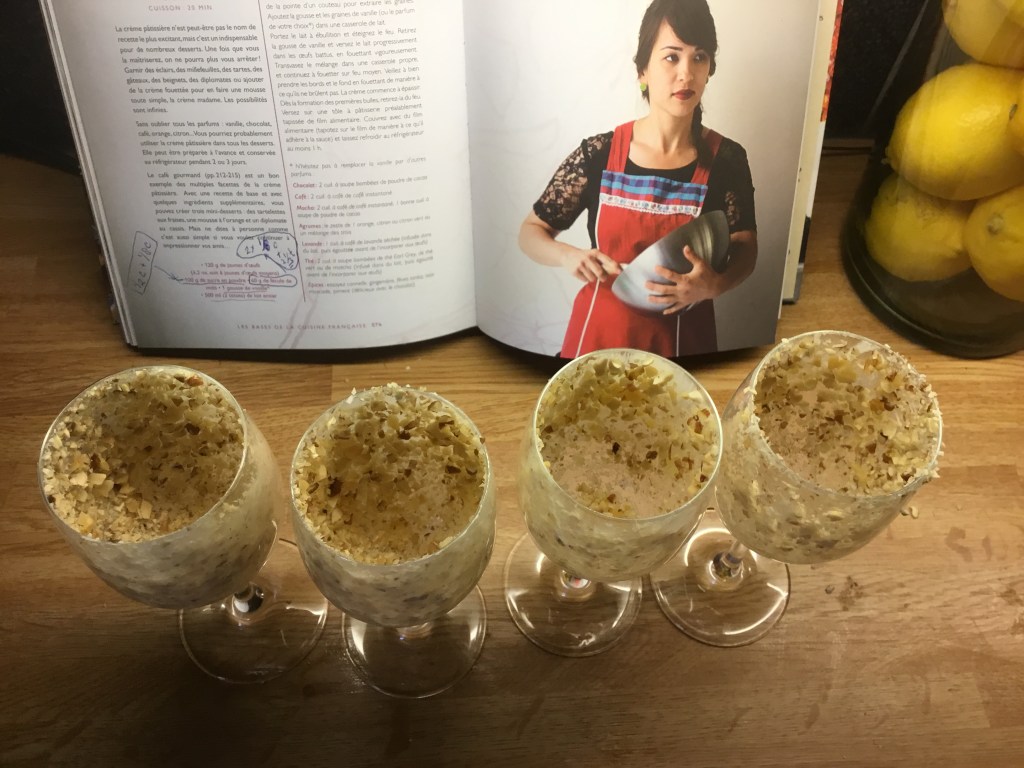
Fold together and add melted chocolate…..
Voila!
#Paris In July Retour à Killybegs
Author: S. Chaladon
Title: Return to Killybegs
Published: 2011
Language: I read it in French…but it is available in English.
- List of Challenges 2019
- Monthly reading plan
- #ParisInJuly
Trivia: Awarded the Grand prix du roman de l’Académie française 2011.
Le Grand Prix du Roman is a French literary award, created in 1918, and given each year by the Académie française. Along with the Prix Goncourt, it is one of the oldest and most prestigious literary awards in France.
Introduction:
Return to Killybegs is a novel about a traitor to Belfast’s Catholic community
during the war in 1970s and 1980s in Northern Ireland.
The narrative is inspired by the 2006 murder of Denis Donaldson.
He was a senior Sinn Féin member who was revealed as a British secret agent.
Chalandon had befriended Donaldson while working as a journalist in Belfast.
Chalandon attempts to understand the reasons for
Donaldson’s (character: Tyrone Meehan) betrayal of the IRA.
Perhaps Chalandon wanted to give his friend a chance to explain his side of the story.
Timeline:
24 December 2006 – 04 April 2007 (narrator is now 81 years old)
” I have often returned to my father’s house
…but I came here four days ago…..to die.”
Best chapters – 18, 21, 22, 23 (suspense)
Conclusion:
The writing is remarkable, compact and to the point.
Chalandon manages a journalistic style
yet breathes life into characters that leave the reader riveted.
Suspense builds while Chalandon alternates the past with the present.
Past: childhood, WWII, entrance into IRA, prison sentences and contre-espionage
Present: visit 2006 in Belfast for a wedding and confrontation with ex-IRA members
Despite the cease-fire, peace negations, destroyed arms caches
…the IRA is still there.





















Paris in July 2019

- Oh, is it July already?
- Let’s have a glass of wine and
- think of some things to do for…
2018 POSTS:
- Paris in July Food Journal
- Crème du Citron
- French Wine
- Biscuits Breton
- Cocktail: Kir Royale
- Cocktail: Soixante-quinze ’75’
- Cocktail: What do I do with Campari, Marguerite Duras?
- Cocktail: Who Pays the Bartender?
- Madeleines
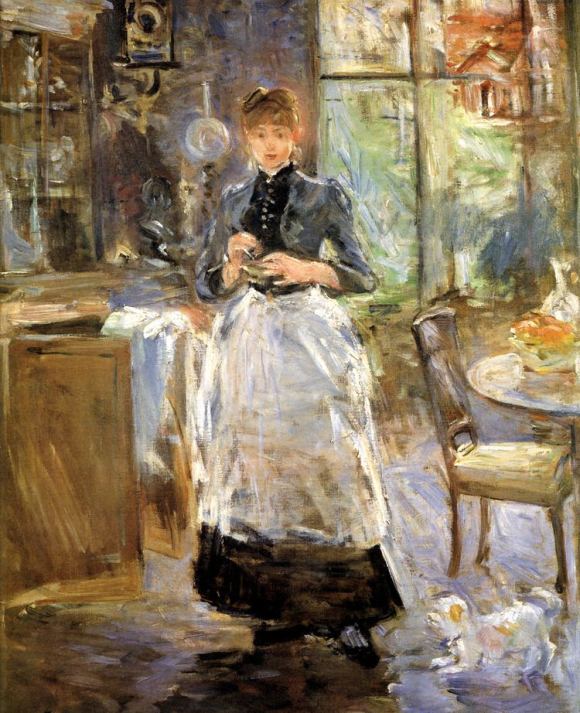
- Biography: Berthe Morisot
- Quiche Lorraine
- List of French Books
- Retour à Killybegs – S. Chalandon (2019)
- Mousse aux éclats de chocolat (2019)
Paris in July
- Paris in July is a French themed blogging
- …experience running from the 1st – 31st July this year.
- The aim of the month is to celebrate our French experiences through
- actual visits, or through reading, watching, listening,
- observing, cooking and eating all things French!
- For more instructions how to share your posts go to Thyme for Tea.
- There will be no rules or targets …just blog about anything French
- …and you can join in! Some ideas might include;
- reading a French themed book – fiction or non-fiction,
- watching a French movie,
- listening to French music,
- cooking French food,
- experiencing French, art, architecture and travel.
- #ParisInJuly2019
2018 Les Prix Littéraires Longlists
Prix Fémina 2018 WINNER Le Lambeau – READ (review)
Le Lambeau – READ (review)
il raconte le calvaire de sa reconstruction
longue et douloureuse, que ce soit physiquement ou mentalement.
Son ouvrage est aussi en lice pour le prix Renaudot.
Shortlist:
David Diop avec Frère d’âme (Seuil),
Gilles Martin-Chauffier pour L’Ère des suspects (Grasset),
Diane Mazloum avec L’Âge d’or (JC Lattès) et
Pierre Notte pour Quitter le rang des assassins (Gallimard).
Le Femina étranger 2018
La Neuvième heure d’Alice Mc Dermott (Quai Voltaire) et
Le Femina essai 2108
Gaspard de la nuit d’Elisabeth de Fontenay (Stock).
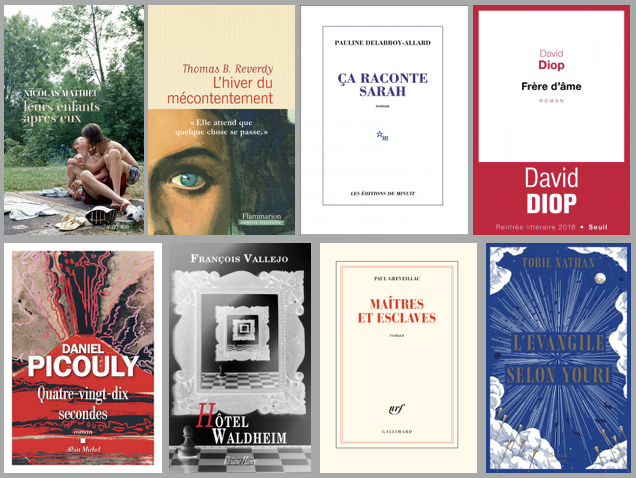
Prix Goncourt 2018
- Nicolas Mathieu, pour Leurs Enfants après eux (SHORTLIST) – WINNER
- Tobie Nathan, pour L’Évangile selon Youri (SHORTLIST)
- Daniel Picouly pour Quatre-vingt-dix secondes (SHORTLIST)
- Thomas B. Reverdy, pour L’Hiver du mécontentement (SHORTLIST)
- François Vallejo, pour Hôtel Waldheim (SHORTLIST)
- Pauline Delabroy-Allard, pour ça raconte Sarah (SHORTLIST)
- David Diop, pour Frère d’âme (SHORTLIST)
- Paul Greveillac, pour Maîtres et Esclaves (SHORTLIST)
- Gilles Martin-Chauffier, pour L’Ère des suspects
- Meryem Alaoui, pour La Vérité sort de la Bouche du cheval
- Inès Bayard, pour Les Malheur du bas
- Guy Boley, pour Quand Dieu boxait en amateur
- Adeline Dieudonné, pour La Vraie Vie
- Clara Dupont-Monod, pour La Révolte
- Éric Fottorino, pour Dix-Sept ans
Prix Reaudot 2018
Le prix Renaudot a été attribué à
Valérie Manteau pour Le sillon qui évoque la figure du journaliste et écrivain Hrant Dink, militant de la cause arménienne assassiné par un nationaliste turc. Elle ne figurait pas dans la liste des finalistes du prix.
Les jurés du prix Renaudot ont en outre attribué un “prix spécial”
à Philippe Lançon pour Le lambeau, qui a déjà remporté le prix Femina.
Shortlist:
Frère d’âme de David Diop (Seuil),
L’ère des suspects de Gilles Martin-Chauffier (Grasset),
Le lambeau de Philippe Lançon (Gallimard),
L’âge d’or de Diane Mazloum (JC Lattès),
Quitter le rang des assassins de Pierre Notte (Gallimard).
Prix Le Médicis 2018
- Tous les hommes désirent naturellement savoir – N. Bouraoui/J. Lattès
- Frère d’âme – David Diop
- Arcadie – Emmanuelle Bayamack-Tam
- Idiotie – Pierre Guyotat – WINNER
- Le lambeau Philippe Lançon, Gallimard
- Tenir jusqu’à l’aube – Carole Fives
- Par les écrans du monde – Fanny Taillandier
- Ca raconte Sarah – Pauline Delabroy-Allard
- Leurs enfants après eux – Nicolas Mathieu
- Au grand lavoir – Sophie Daull
- L’eau qui passe – Franck Maubert
- Le coeur blanc – Catherine Poulain
#Paris In July Quiche Lorraine
- I just heard from Tamara @Thyme-For-Tea
- that #ParisInJuly has been extended until this Saturday.
- Here is my LAST post…and I want to share my
- French cooking experience.
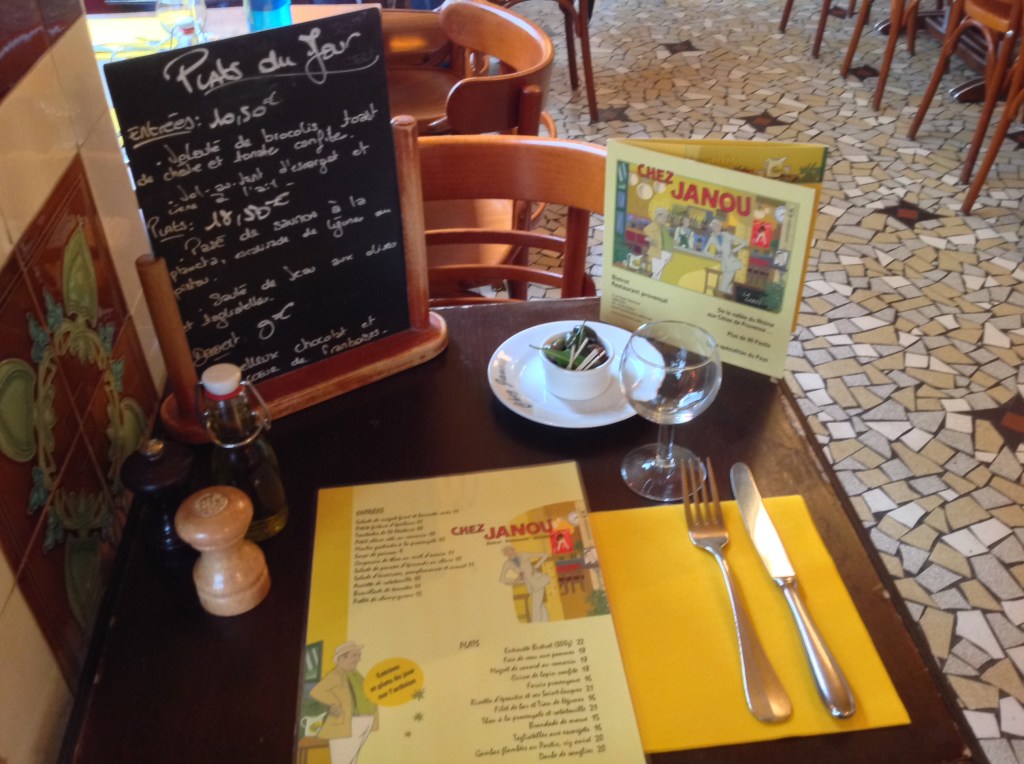
- I had a great lunch in Le Marais by Chez Janou
- 2 Rue Roger Verlomme, Paris.
- Here is the menu in this bistrot provençal.
- Today I made one of my favorite bistrot food: Quiche lorraine.
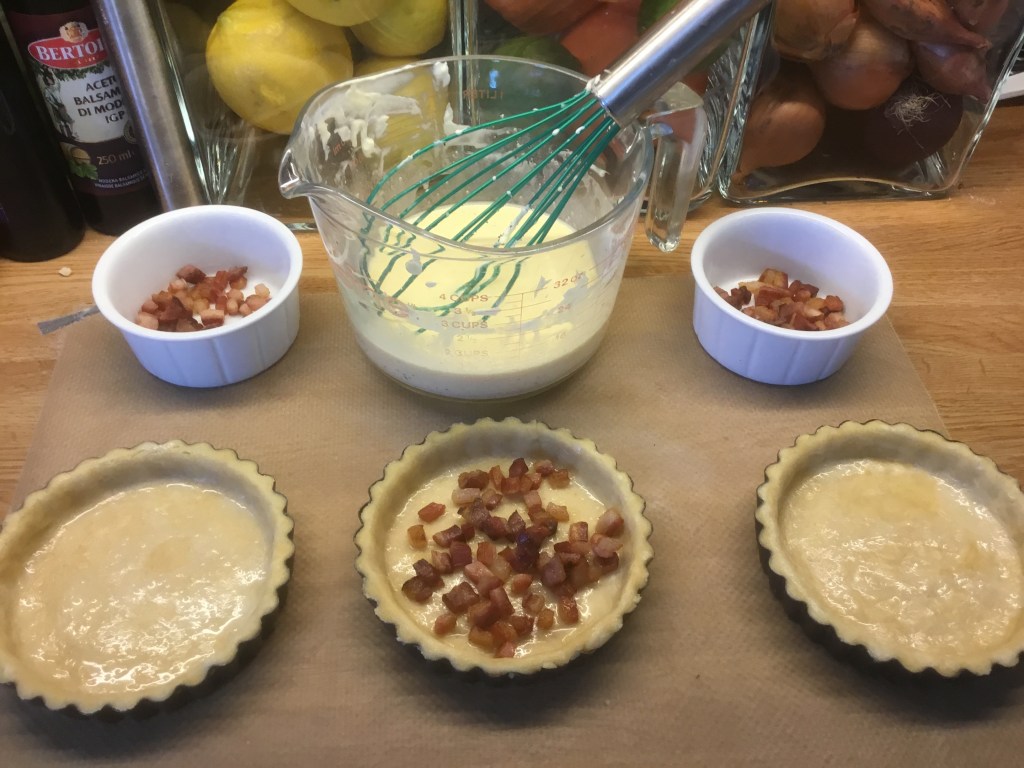
- I made the short pastry dough and this yielded 3 mini quiche.
- Problem: how to get the pastery in those little pans?
- As you can see I cut a round 13 cm and placed over the tin.
- Then I gathered the dough and rolled out another 13 cm round etc.
- You can find the recipe in La Petite Cuisine à Paris by R. Khoo (pg 100)
- Mini Quiche Lorraine: 180 C (350 F) – 20 min
- Have a look at the photos!
Préparation:

Assembler:
Bon Appétit!

Biography: Berthe Morisot ‘Impressioniste’
- Author: D. Bona
- Title: Berthe Morisot: Le Secret de la femme en noir
- Published: 2000
- Language: French
- Trivia: Prix Goncourt de la Biographie 2000
- List Reading Challenges 2018
- Monthly reading planning
- #20BooksOfSummer
- List of Non-Fiction Books Read
Conclusion:
- This book was such an entertaining read.
- If you want to sharpen your ‘French Skills’
- I would recommend this book in a heartbeat.
- The French is easy to follow
- …and Berthe Morisot’s life is very interesting.
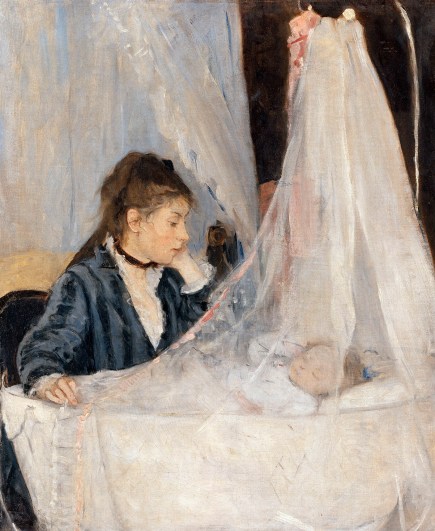
- Above is her ‘chef-d’oeuvre’ Le Berceau (1872).
- She painted her sister Edma and niece Blanche.
- Notice the shimmering quality of the cradle’s veil
- …the diagonal lines of the drapes behind Edma
- and flowing around the cradle.
- Notice the mother’s intimate gaze upon her infant
- …a moment of reflection, silence, peace with her
- …cheek leaning on her hand.
- Notice Edma’s bent left arm
- …a mirror image of the child’s arm.
- This paining is absolutely breathless.
- Trivia: After unsuccessful attempts to sell the painting
- …Le Berceau stayed in the model’s family
- …until it was bought by the Louvre in 1930.
Did you know?
Morisot was anorexic and at times fainted in front of the painting she was working on. After the birth of her daughter 1878 Berthe finally felt true joy. Her body rejuvenated and the dark circles under her eyes vanished.
Morisot was always referred to as ‘Madame’ by fellow artists and never Berthe.
Never commercially successful during her lifetime, she nevertheless outsold Claude Monet, Pierre-Auguste Renoir, and Alfred Sisley.
Morisot painted only 1 adult male...her husband Eugène Manet.


Last thoughts:
- I enjoy reading in French but it took me 5 years to
- build up a vocabulary.
- Of course I am still looking up words.
- A book that is easy to start with is the prize winning
- Charlotte by David Foenkinos.
- It was awarded Prix Renaudot 2014.
- Here is the LINK and I know you will enjoy it!
- Learning a 2nd or 3rd language opens up an entire
- new library for you.
- I can read books in English, French and Dutch!
- If I really try….I can get through a German book.
- All you have to do is choose a book
- …use this LINK for a very
- …good digital French-English dictionary (or other languages)
- …and you are starting a great adventure!
- Here is the list of the French Books Read.
- I have included reviews of books 2017 – 2018
Berthe Morisot:
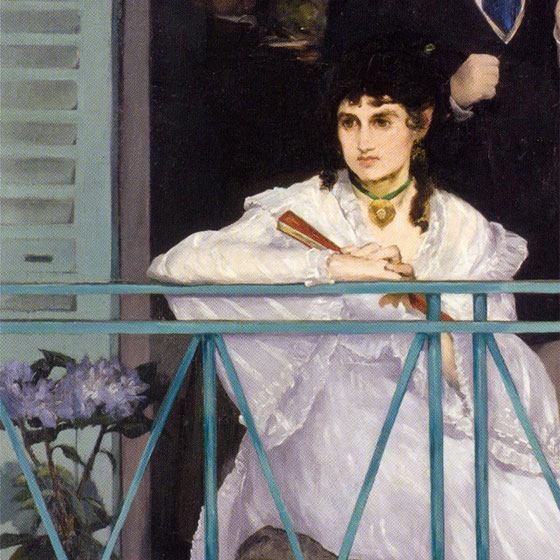
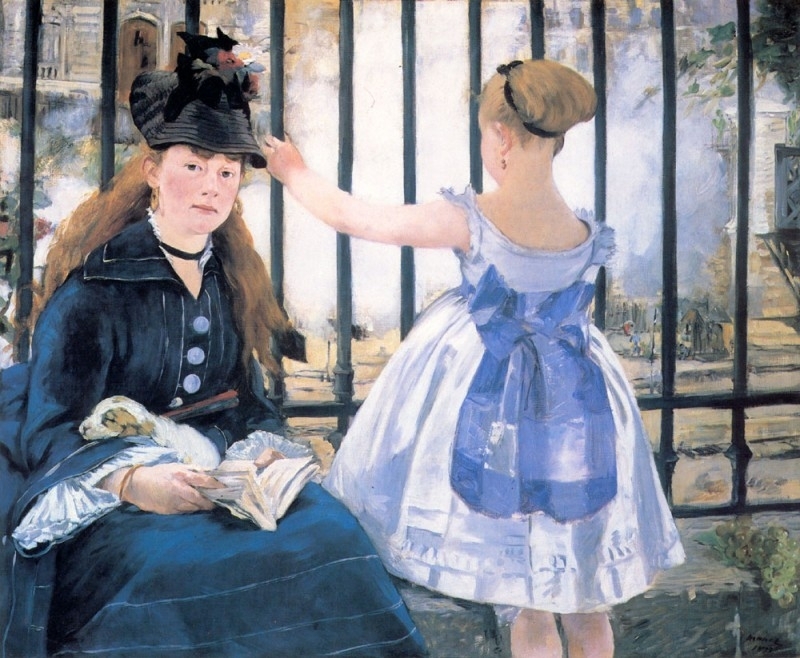
Le Balcon, E. Manet

#Paris In July Madeleines
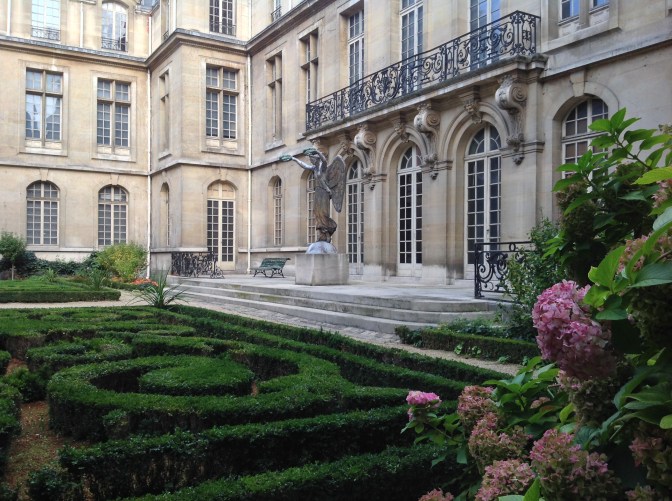
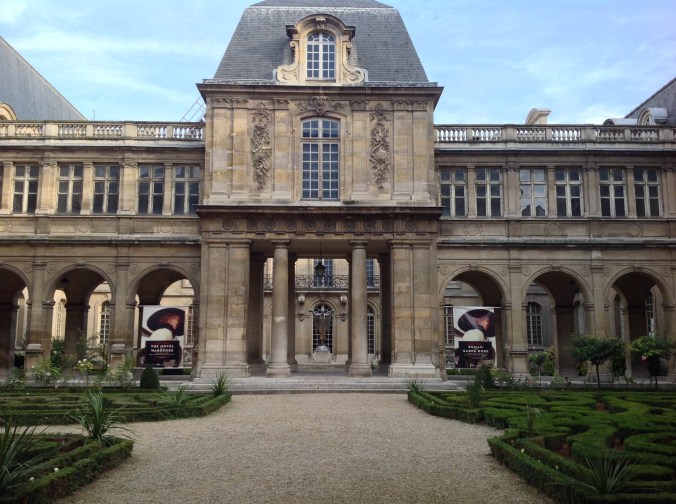
Musée Carnavalet:
Un voyage dans le Paris de la Belle Époque sur les pas de Marcel Proust, à la recherche d’un temps perdu…
What is the first thing you think of when you say Marcel Proust?
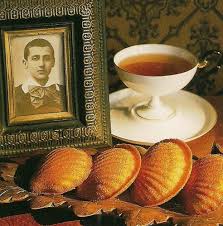
- Yes…and that is what I am going to try to make!
- Recipe is in La Petite Cuisine à Paris, page 88
- Madeleines à la crème de citron
Preparation:

Batter:
In three easy steps:
- Kitchen Aid (…if you have one) : mix eggs and sugar until frothy and pale yellow
- Bowl nr 1: sieve flour and baking powder then add the zest of 1 lemon
- Large bowl nr 2: mix milk with cooled melted butter then
- …add flour mixture is 2 parts.
- Let batter cool if fridge for a few hours or overnight.
- The recipe is in La Peitie Cuisine à Paris by R. Khoo, pg 88.
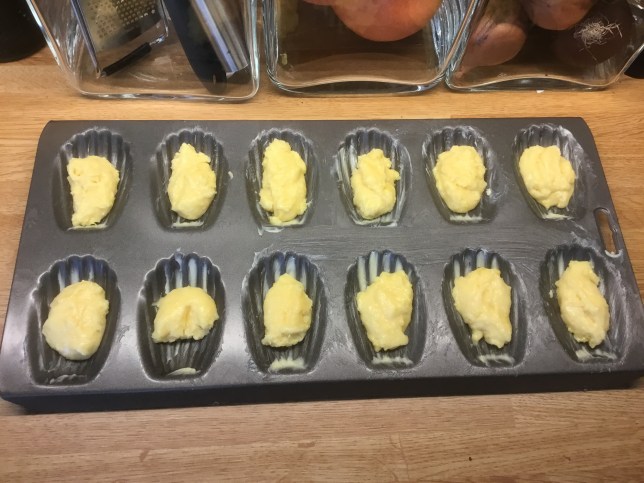
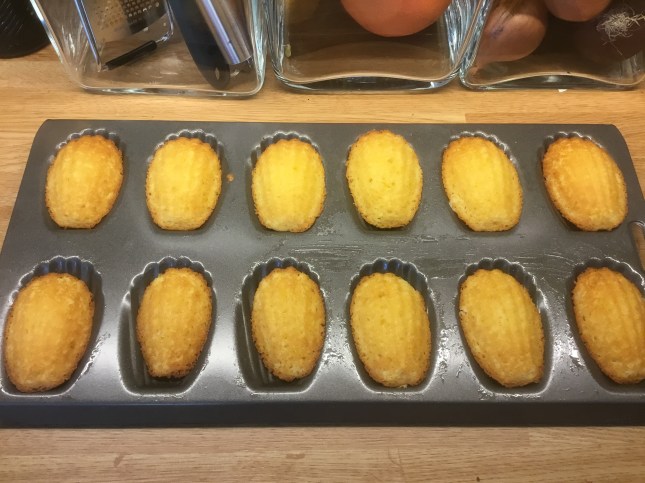
- I was up early this morning and baked the little cakes.
- Just 1 level tablespoon is enough batter in each form.
- You have to stay near the oven because these delicacies
- …bake quickly and you don’t want to burn them!
- Makes: 42 madeleines
- NOTE: this is the strangest recipe because you have to ‘manipulate the oven’.
- 190 C (375 F) – bake madeleines for 5 minutes
- turn OFF oven for 1 minute
- turn oven ON reduce temp to 160 C (320 F) – bake for 5 min
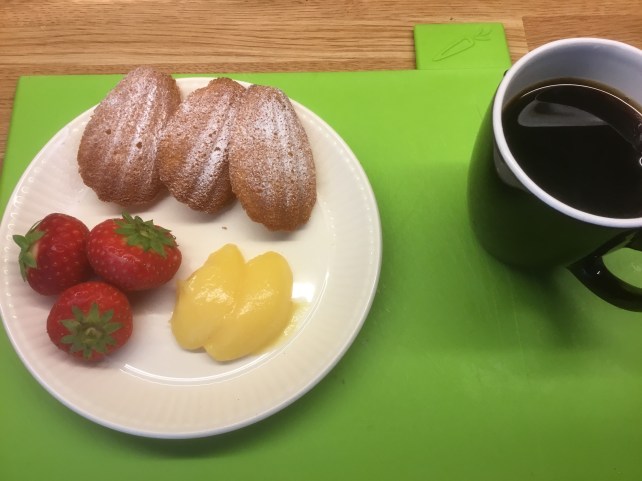
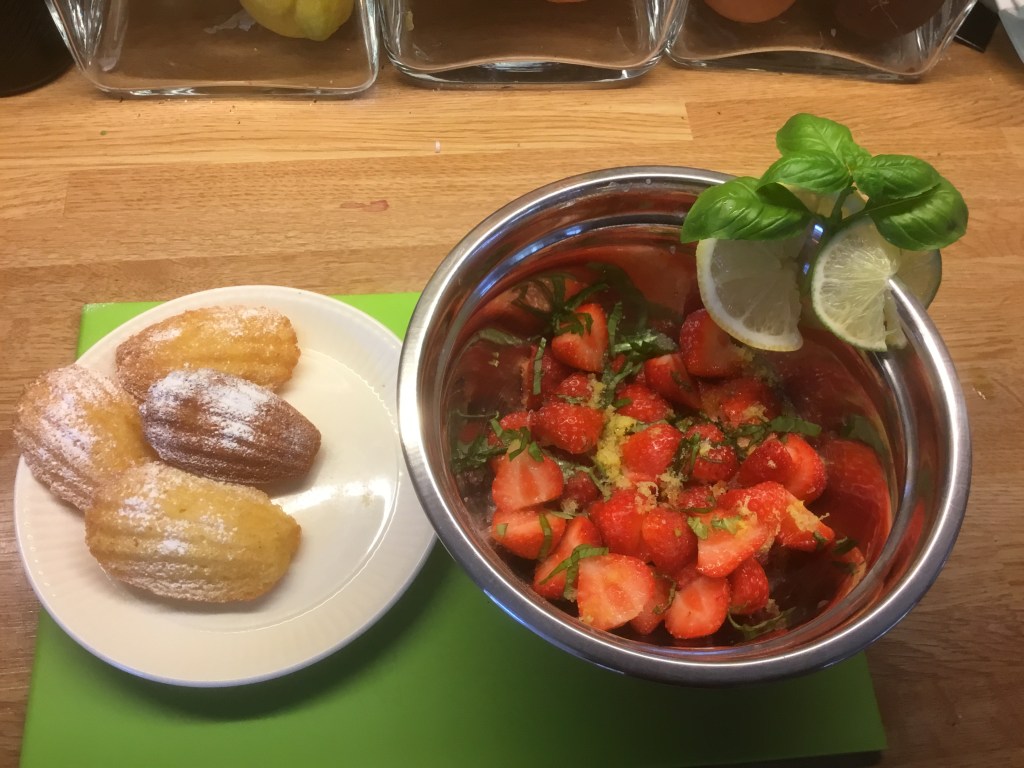
I made some French Strawberry Shortcake with a mixture of
Fraises au basilic et au citron
- 500 gr strawberries
- 1 TB lemon juice + zest of 1 lemon
- Sugar (..to your own taste)
- 6 chopped 6 basil leaves
- twist of the peppermill!
 NancyElin.blog