
#Non-Fiction The Dead Are Arising
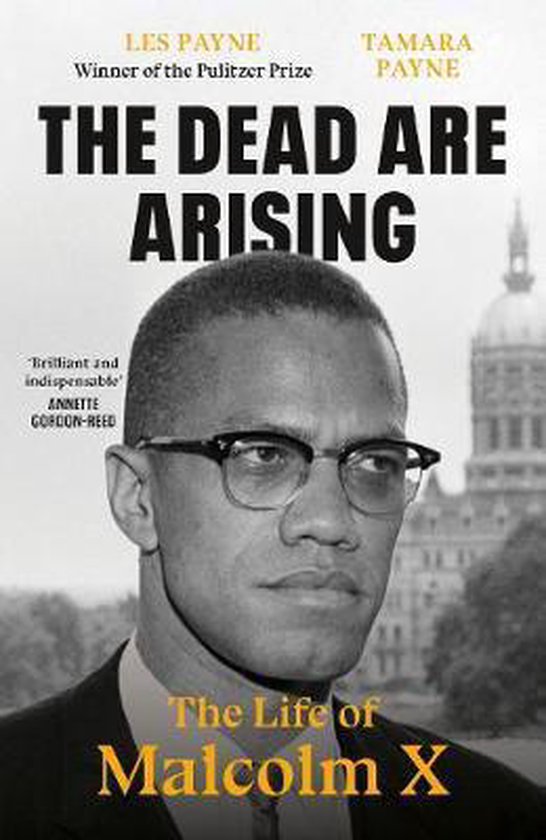
- Author: Les Payne (1941-2018)
- Title: The Dead Are Arising
- Published: 2020
- Genre: novel (4 parts, 19 chapters, pg 640)
- Trivia: winner National Book Award for Nonfiction 2020
- Trivia: winner Pulitzer Prize Biography 2021
- List of Challenges 2021
- Monthly plan
Conclusion:
- Decades of research went into the creation of
- The Dead Are Arising: The Life of Malcolm X
- by Les Payne and Tamara Payne, a fully realized portrait of Malcolm X.
- Pulitzer Prize winner Les Payne set out to interview anyone
- who had ever known Malcolm X, and after his death in 2018,
- his daughter and researcher Tamara Payne completed his work.
- This was a absloutely stunning book!
- Part 1: Malcolm’s young years 1- 15 yrs
- Part 2: Malcom move to live with half sister in Boston
- ….he is street wise and soon ends up in jail.
- These two sections are just the pre-show
- …and can feel a bit slow at times.
- Do not stop reading because Malcolm’s biography
- … is a riveting a page-turner!
- Les Payne has included many new items of information
- that Malcolm X…LEFT out of his own
- …autobiography written with Alex Haley.
Last Thoughts:
- This book filled in a lot of gaps in my memory of the 1960s.
- Growing up I had heard of Malcom X
- ….but only knew he was assassinated on February 25 1965.
- Why? Who was involved? I had no idea.
- The mainstream media placed
- …the spotlight on Martin Luther King
- …and left Malcom X in the shadows of my mind.
- Now…finally I know why Malcom X was killed
- …but it took 55 years and the painstaking research of Les Payne
- to solve this crime
- #MustRead
 NancyElin.blog
This sounds excellent, what a pity the author didn’t live to see it published.
The author was mentioned in the book as one of the college students
who attended a lecture/speech by Malcolm X
Introduction:
“…Malcolm also changed the way Les Payne viewed himself. As a college student in 1963, he had heard Malcolm speak in Hartford, Connecticut
On that June night, my father (introduction was written by Payne’s co-author, his daughter) came face-to-face with his own self-loathing. Malcolm X addressed the race issue head-on:
“Now I know you don’t want to be called ‘Black,’ ” he said. … ”You want to be called ‘Negro.’ But what does ‘Negro’ mean except ‘black’ in Spanish? So what you are saying is: ‘It’s OK to call me ‘black’ in Spanish, but don’t call me black in English.”
Later, in “The Night I Stopped Being a Negro,” an essay that was first published in a collection titled “When Race Becomes Real,” Payne wrote that he (Les Payne) had entered “Bushnell Hall as a Negro with a capital ‘N’ and wandered out into the parking lot—as a Black man.”
The book was deeply personal for Les Payne.
Thanks for your comment!